
The 2026 Colorado River Negotiations: States at impasse, federal government steps in...
“The good news is that the Colorado River crisis should be far easier to solve than most other problems we face as a nation. By changing our irrigation practices, we can leave a lot of water in the river where it belongs. It really gets to our nation’s soul, reminding us that we have trampled on Native American rights, decimated the environment, and destroyed centuries-old cultures so we can export our water, via all that hay, even to countries that are not always aligned with democratic values.”
–Excerpt from Whose Law of the River?, p. 12
About the book:
Whose Law of the River?
by Ken Ransford
E-book now available on Kindle.
Hardcover coming out mid-September 2026
For over 20 years, Ken Ransford has served on a volunteer citizens' board in Colorado that state officials organized as a grassroots-level advisory board for Colorado River policy, regulation and legislation. As secretary of the board, Ken's ringside seat offered a granular view of the procrastination crisis that has forced what amounts to a national deadline in 2026.
Whose Law of the River? connects the dots across states, nations, and timelines to explain how dozens of major decisions have set us up for what amounts to comprehensive Colorado River usage reform with 2026 deadlines that the Trump Administration has indicated it intends to meet. To understand the generational changes on the way, requires knowledge of how we got here... and whose law of the river will prevail.
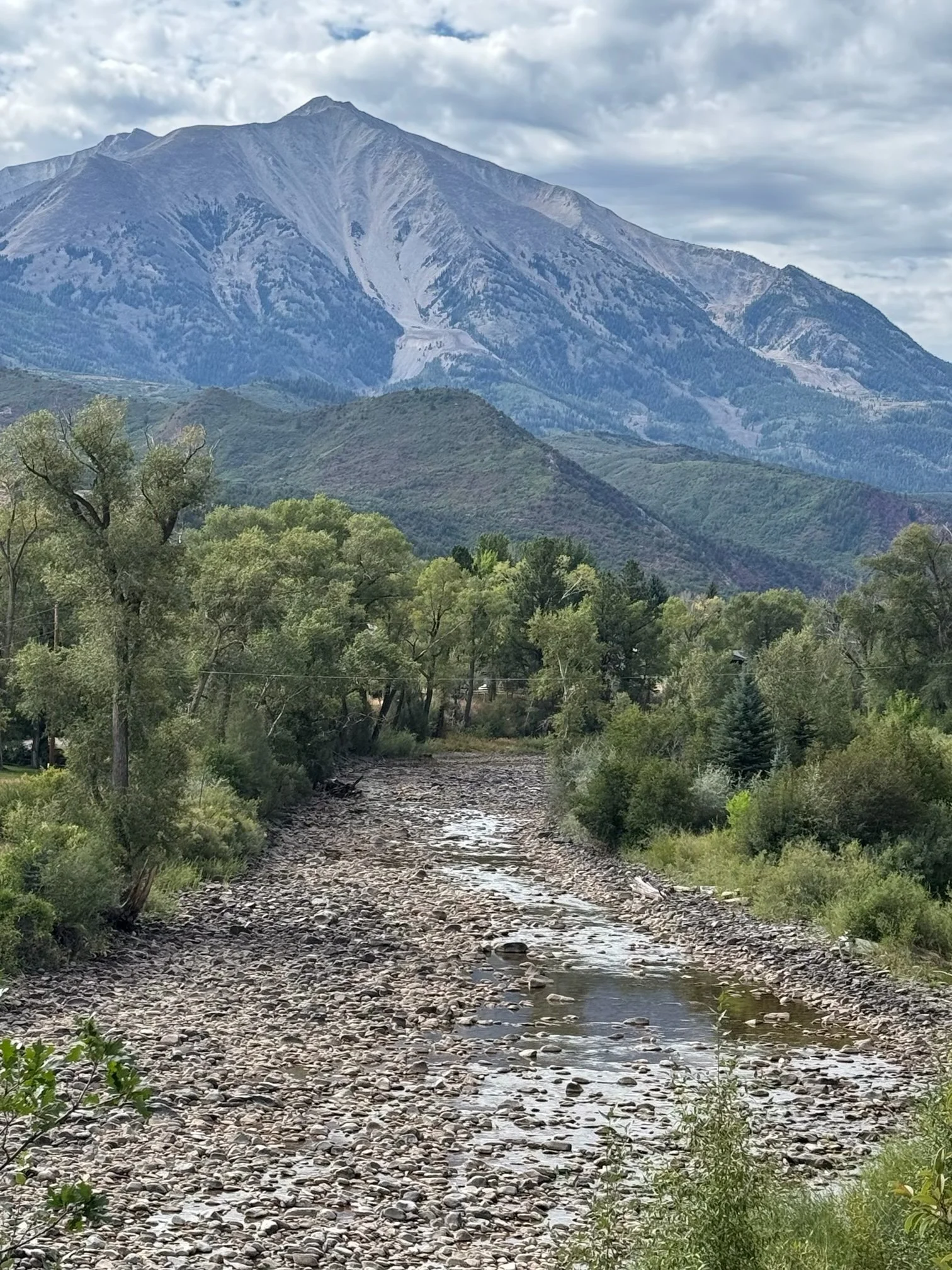
“This photo I took of the Crystal River in Carbondale, Colorado, illustrates why I wrote “Whose Law of the River?”. Water levels in the Colorado River will continue to diminish unless we change the current laws and practices to consider climate change and encourage efficient irrigation, rather than the antiquated ‘use it or lose it’ policies still governing water laws.”
–Ken Ransford, author
About the Author:
Ken Ransford

Ken Ransford is a licensed lawyer, CPA, and Registered Investment Advisor in Basalt, Colorado. His Bachelor’s Degree is from the University of California, Davis, Phi Beta Kappa, 1978, and his law degree is from the University of Colorado, 1984.
Ken has been the Secretary to the Colorado Basin Roundtable since 2005, which represents the Colorado River Basin in drafting Colorado’s Water Plan, and has served as the recreational representative to the Roundtable since 2008.
His book he, Whose Law of the River?, is informed, in part, by his experience at the Colorado Basin Roundtable, and driven by his passion for the outdoors, including kayaking the Colorado, skiing, and hiking in California’s High Sierra. The book is available now on Kindle and will be available in mid-September as a hard cover.
In this 8-part series, Ken Ransford speaks about the challenges in today’s river laws and the historic opportunity to keep more water in the Colorado River as we enter the 2026 Negotiations.
Podcast
The Colorado River Crisis in Images
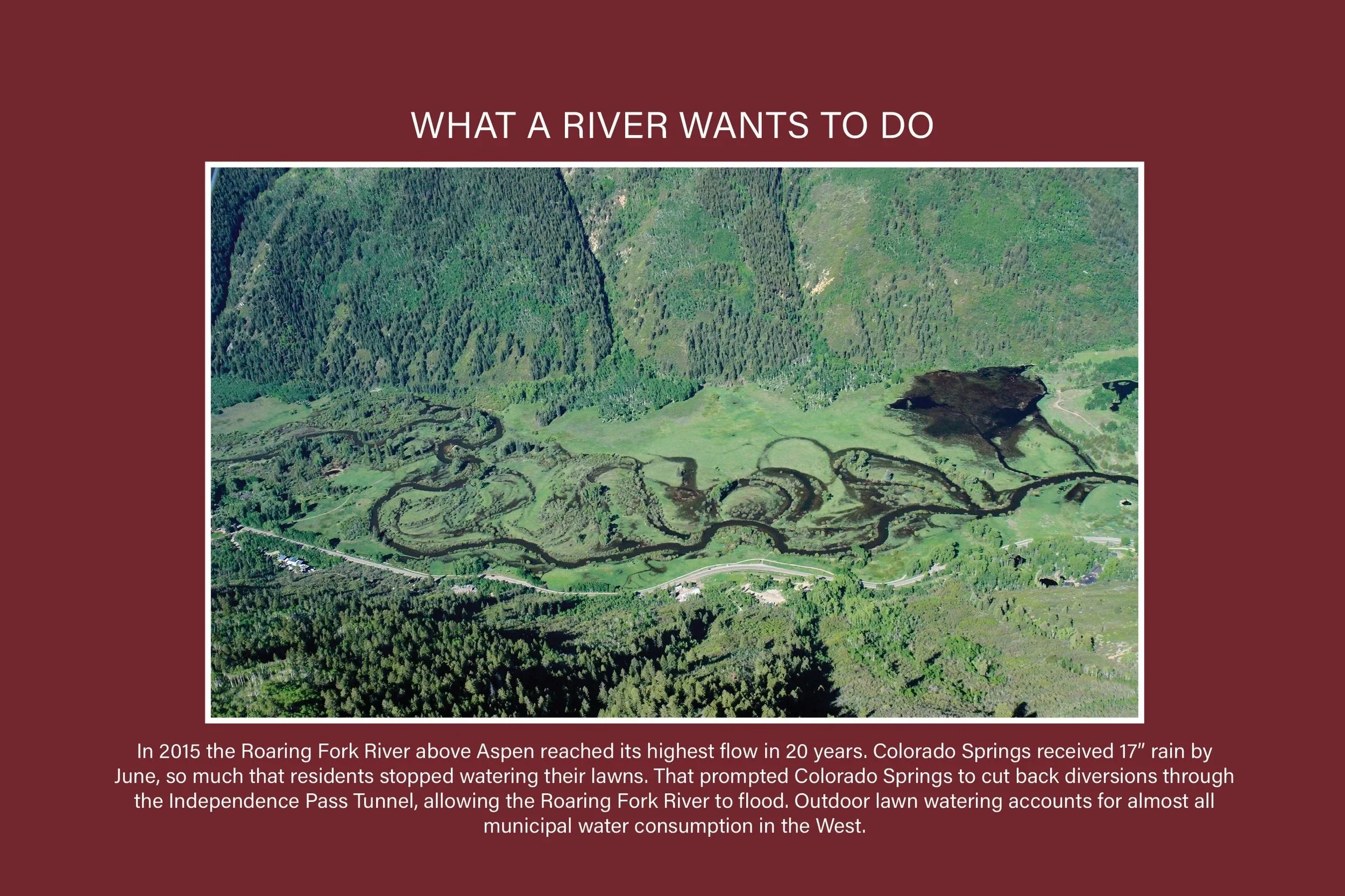
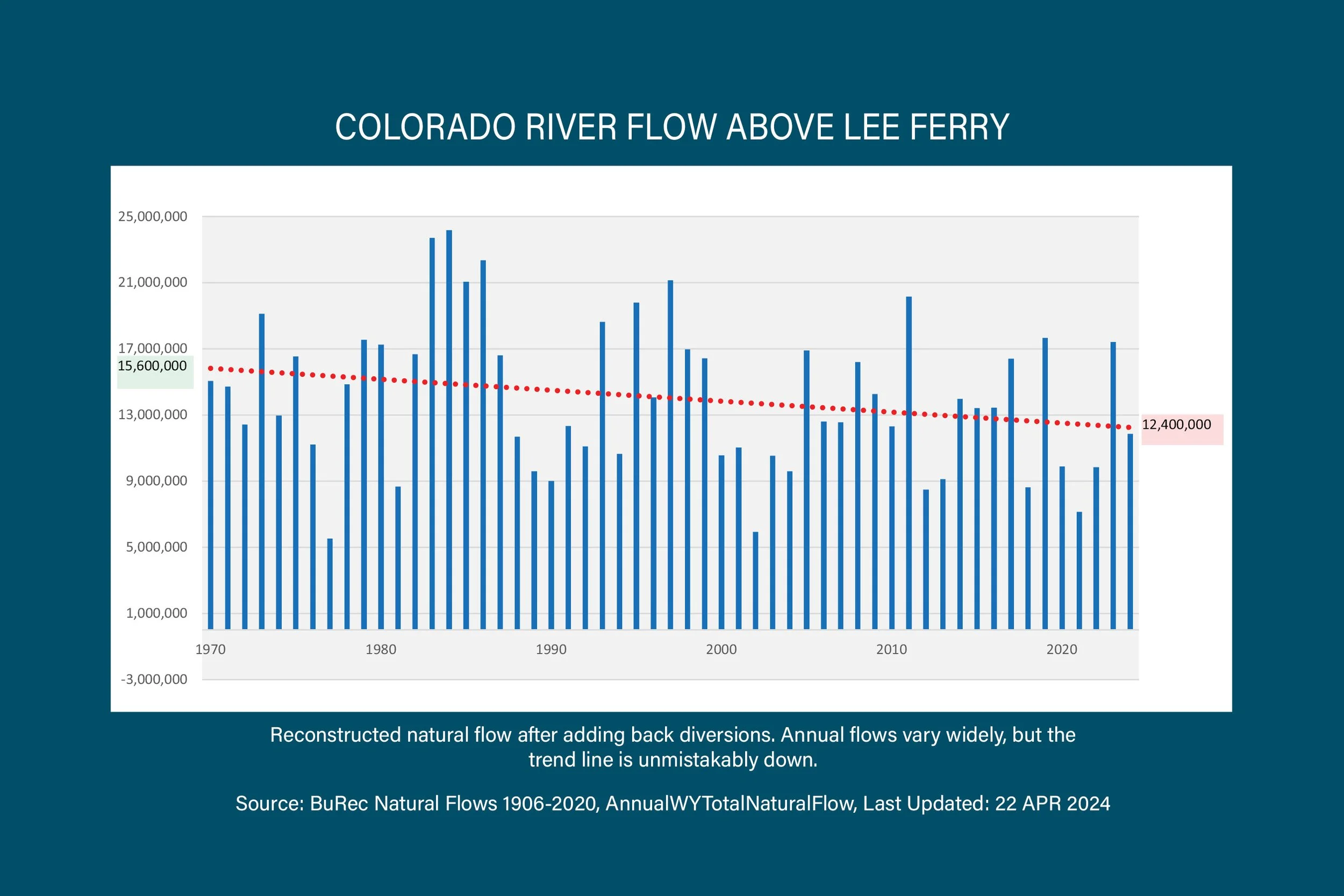
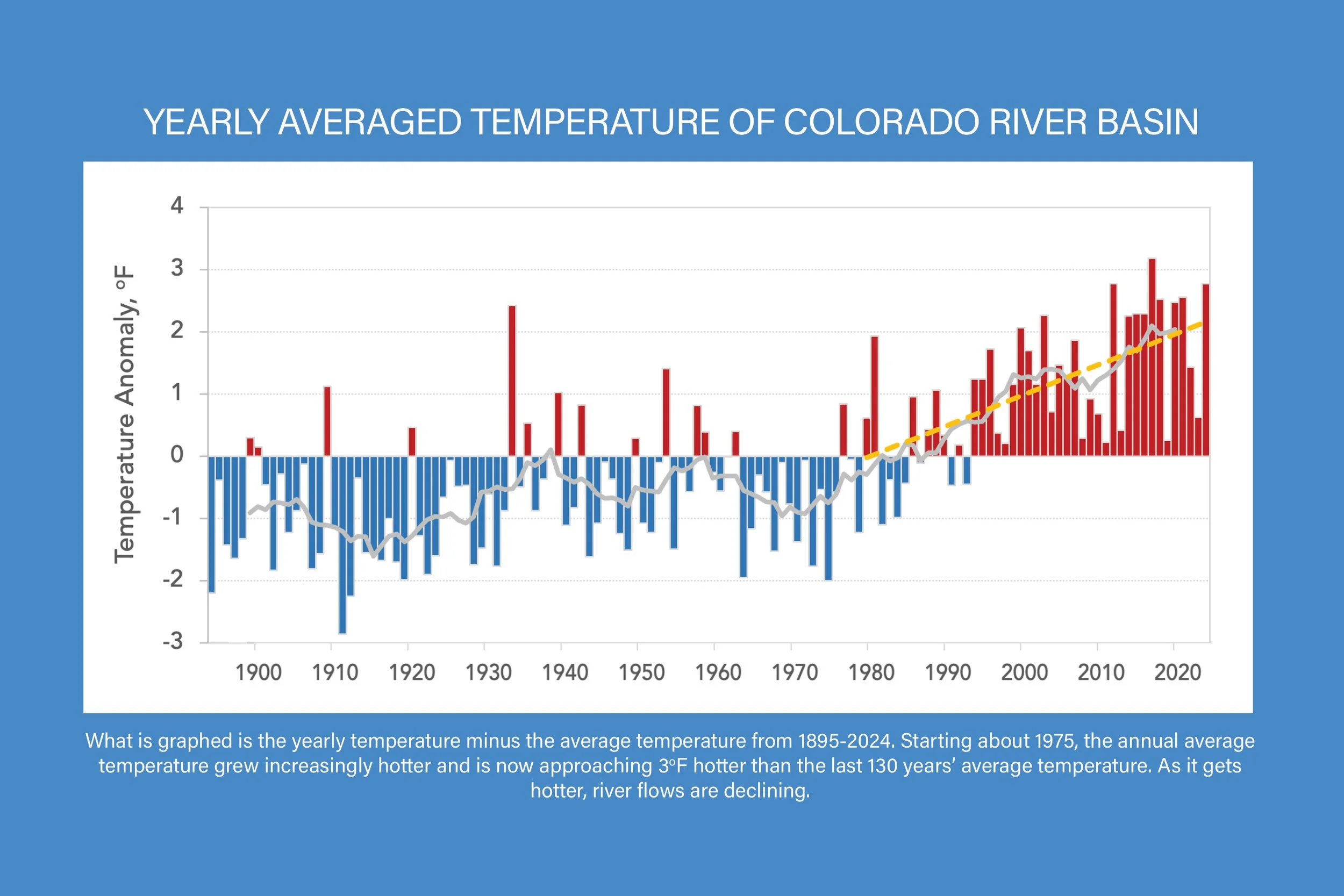
In Whose Law of the River?, author Ken Ransford illustrates below the top issues being discussed – and contributing to the 7-state impasse – for the Colorado River 2026 Negotiations. Now the federal government is stepping in.

Hay Production and Exports
The 100th Meridian
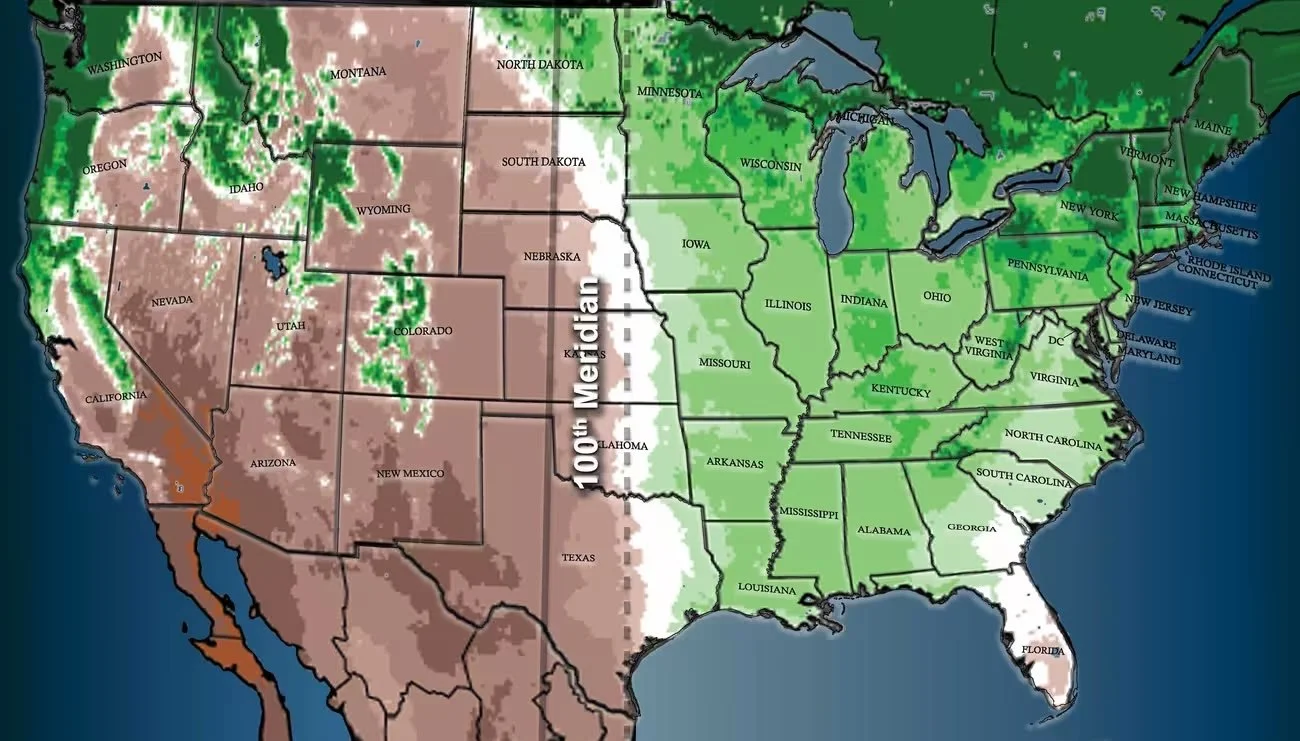
The 100th Meridian (solid line) has long been considered the divide between the East and the more arid West. Climate change may already have started shifting the divide eastward (dotted line). To the east, 70% of the crop is moisture-loving corn; to the west, aridity-resistant hay is dominant. Source: Columbia Climate School.
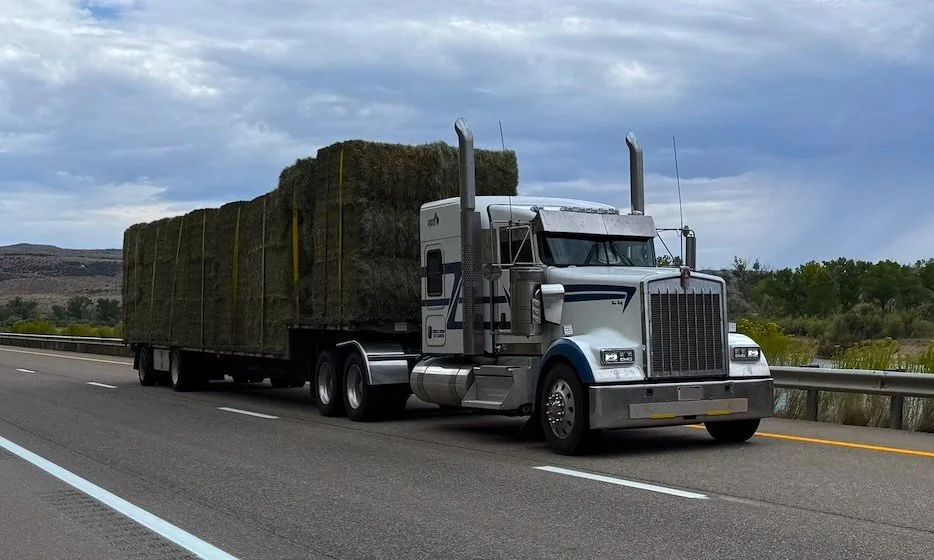
Truckload of Hay
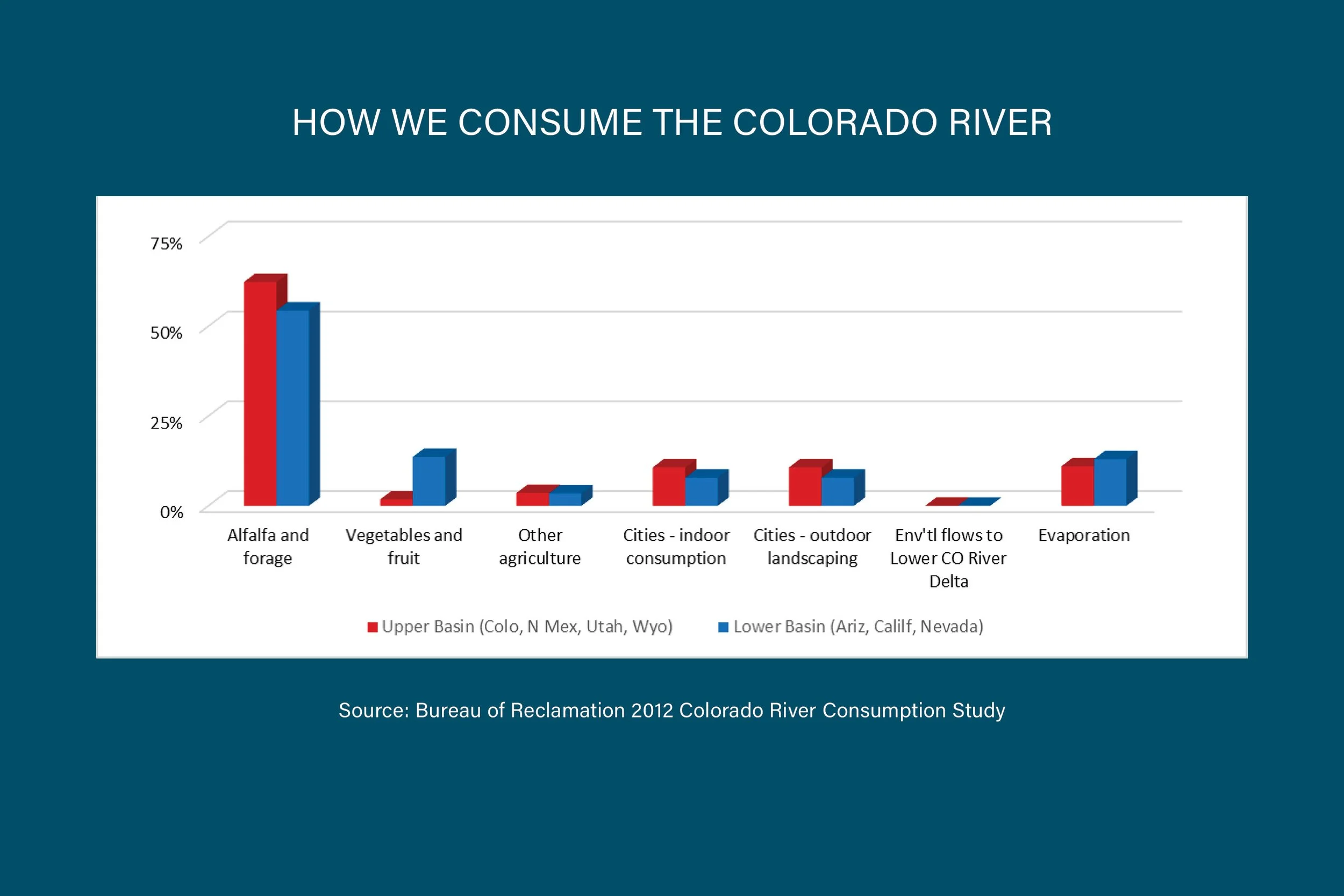
76% of Lower Colorado River irrigation water is used to irrigate hay fields.
Irrigators export up to 30% of the hay to China, Japan, and Saudi Arabia.
Tanker Truck
It takes 686 tanker trucks of water to grow each truckload of cured and dried hay.
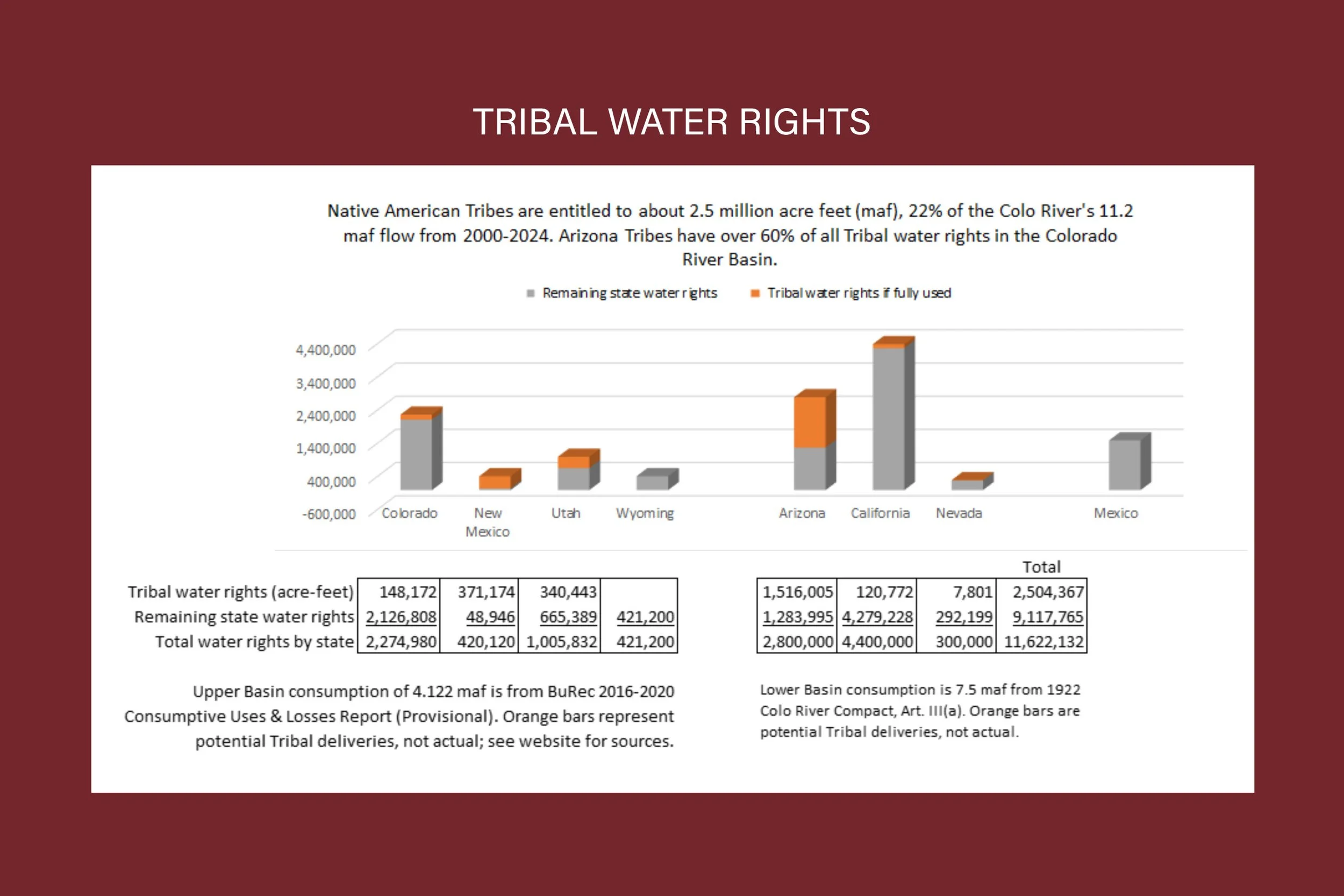
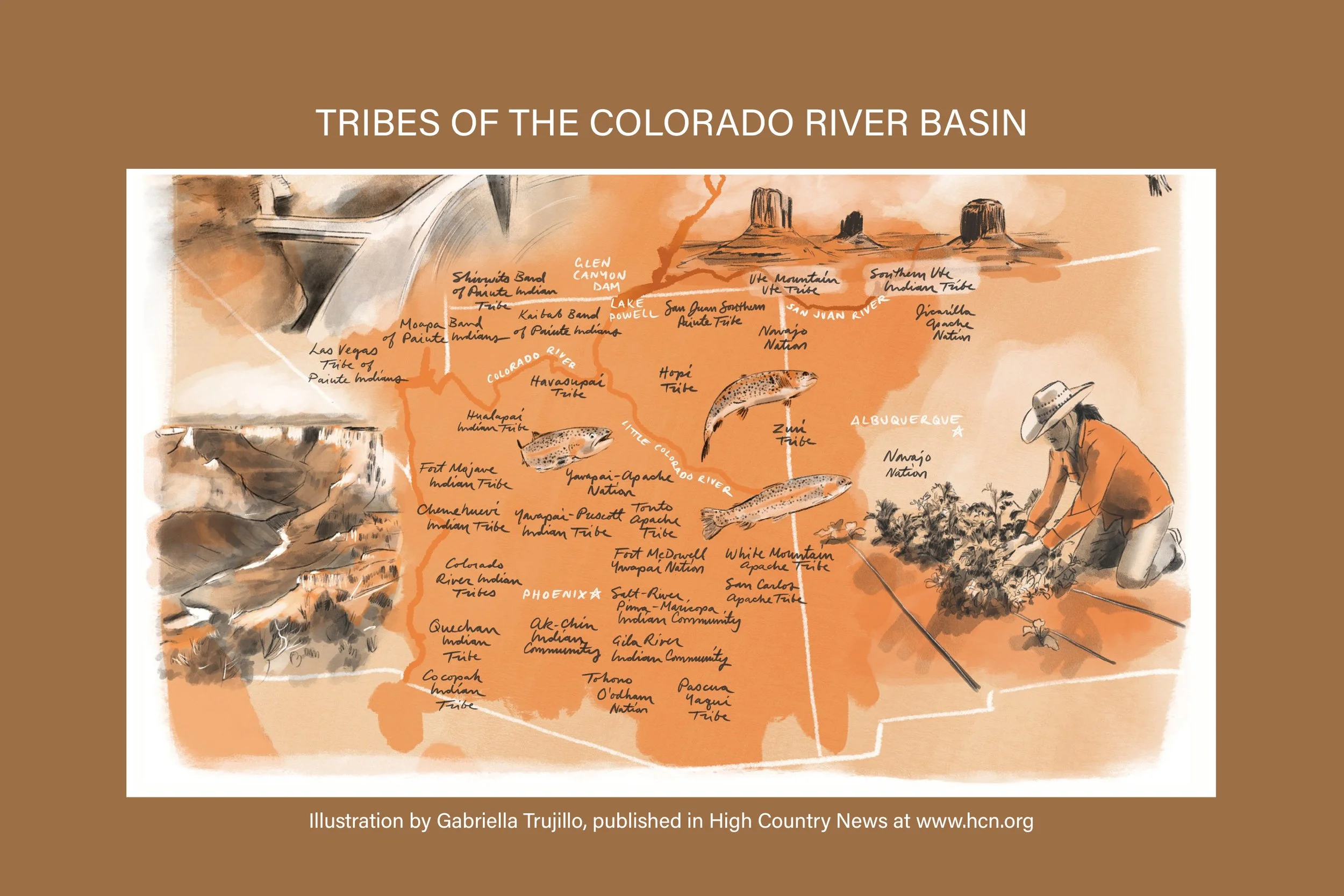
“The Colorado River Indian Tribes (CRIT) claim 23% of Arizona’s entire allocation of Colorado River water and that Arizona v. California says they have the highest priority claim on the river of all tribal water rights. Despite their high-priority status, the CRIT were excluded from the 1922 Compact negotiations and the 2007 Guidelines that now govern releases from Lake Powell and Lake Mead.”
Native America Colorado River Water Rights
Ken Ransford has done extensive research to estimate the amount of water that should be allocated to Native Americans along the Colorado River. Ken’s table at the link below concludes that tribes have 2,504,367 acre-feet, or 2.5 million maf, of consumptive water rights to the Colorado River.
Colorado Water Projects
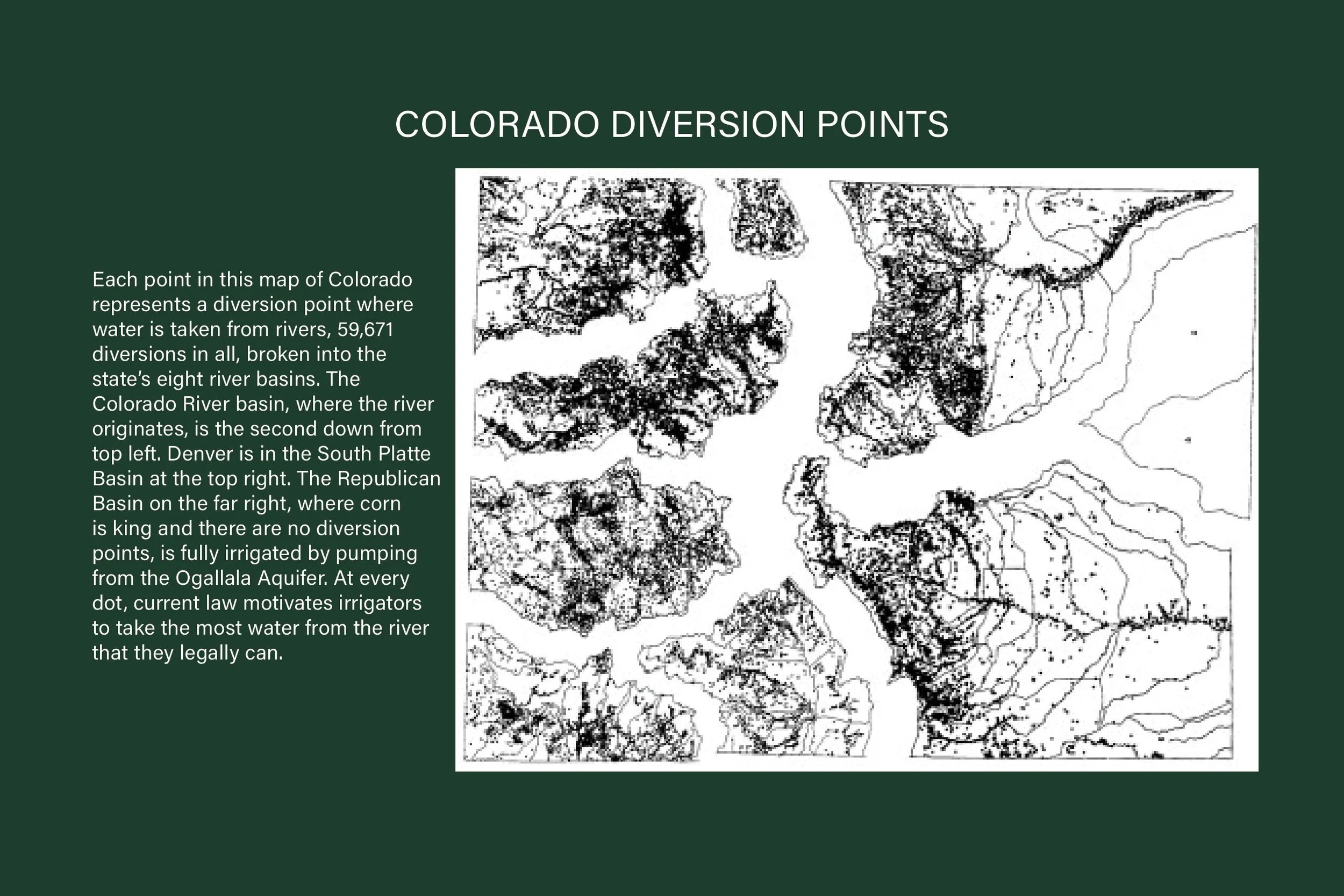
Colorado Water Project maps. For additional information detailing existing diversions, see Colorado Water Law and Practice below, Chapter 17, On Transmountain Diversions, or Chapter 18, Always New Supply.
Click image to enlarge.
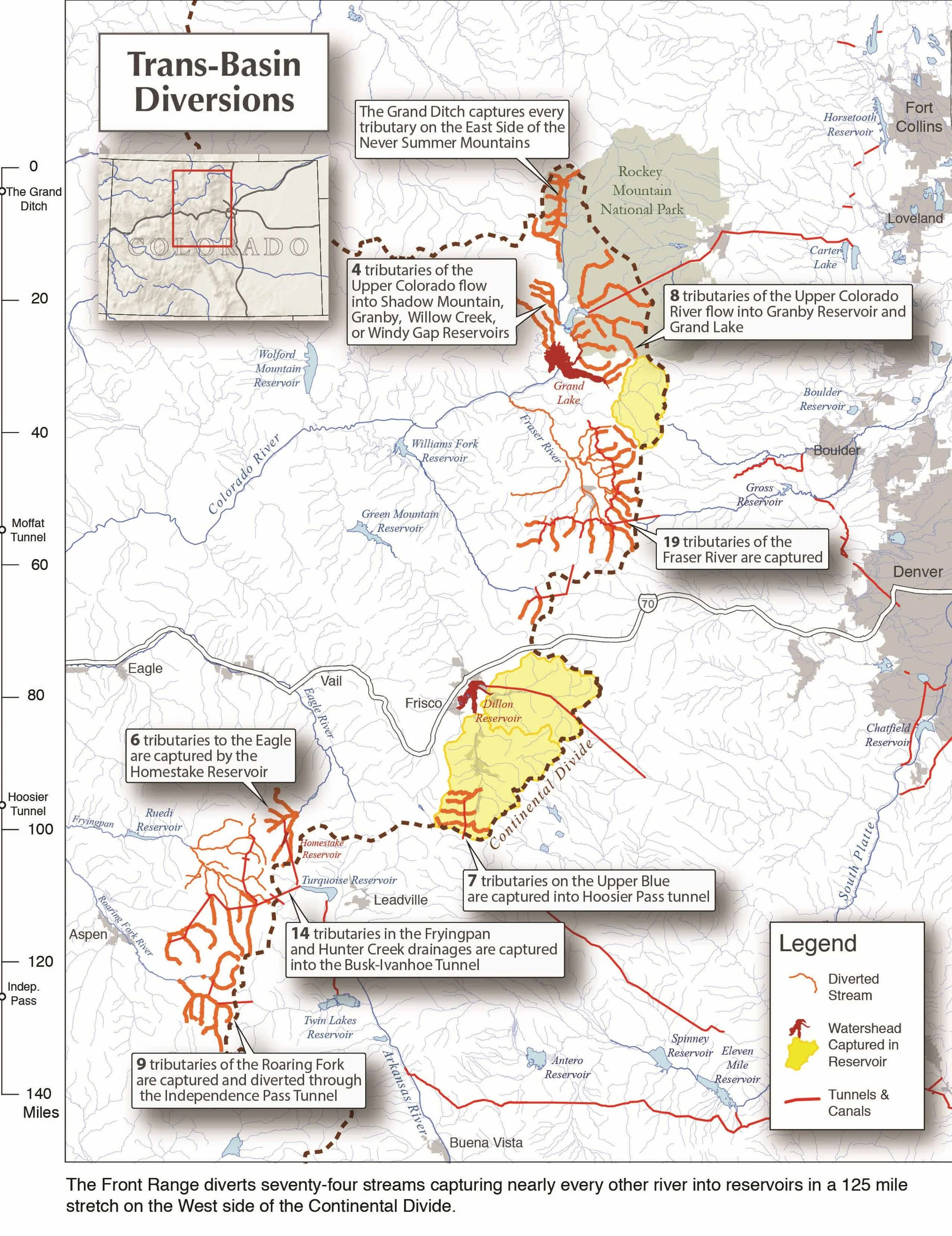
Existing Trans-Basin Diversions: Tunnels and diversions capture over 70 headwater streams on Colorado’s West Slope near the Continental Divide, shunting them into tunnels and ditches for delivery to the Front Range on the East Slope.
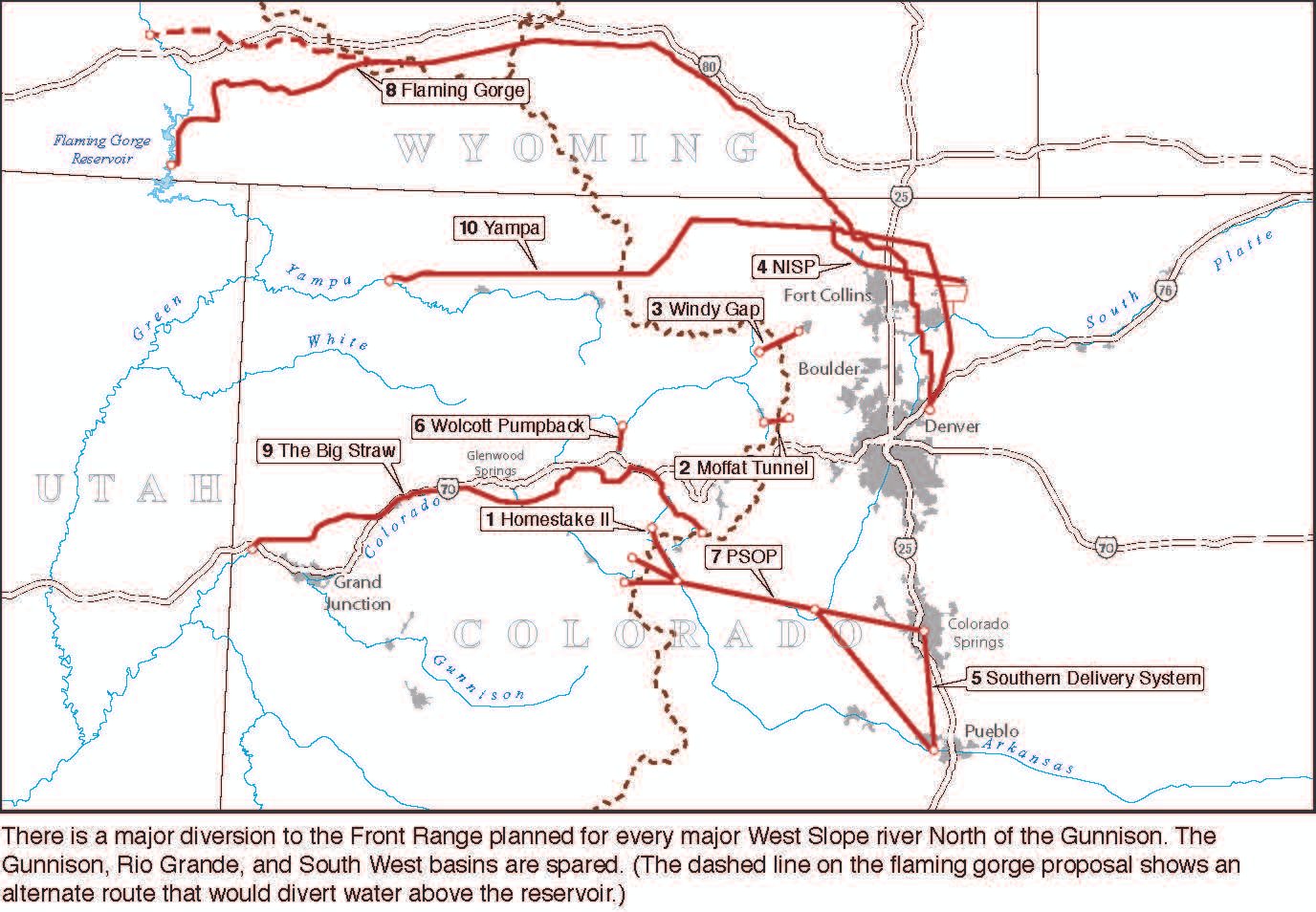
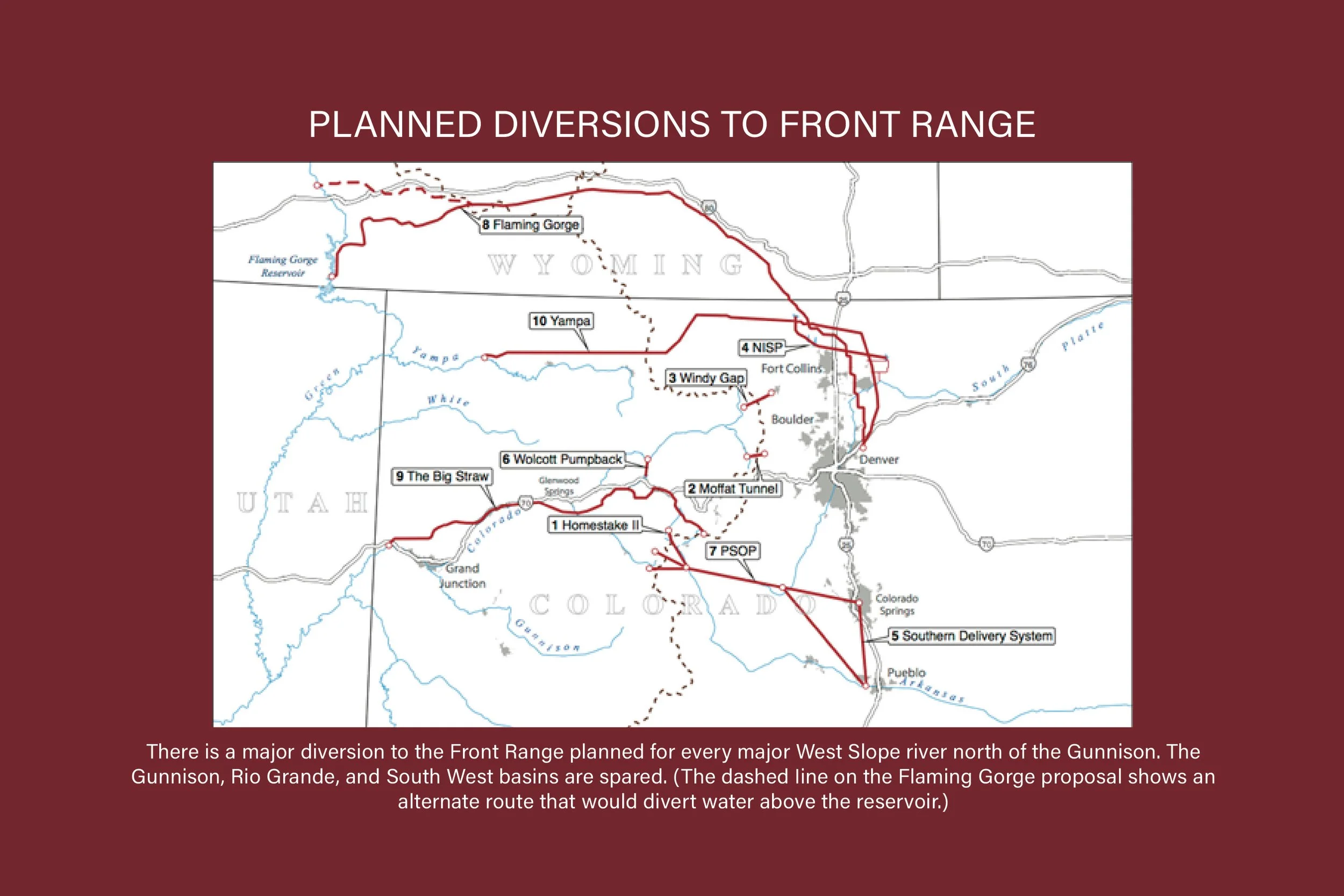
New Supply Projects proposed in Colorado: Ten water projects have been proposed or are in various stages of development from Colorado’s West Slope to the East Slope.
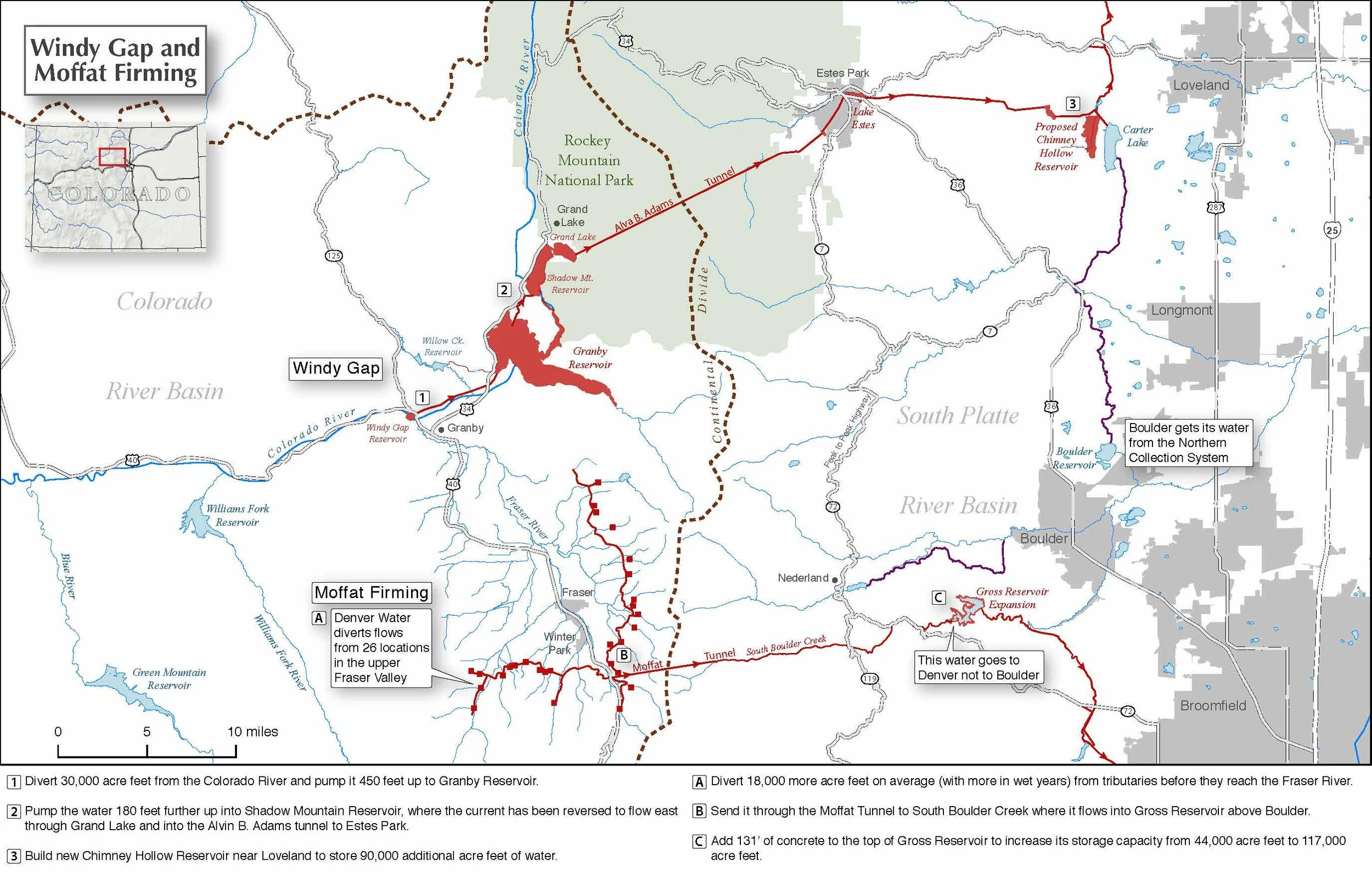
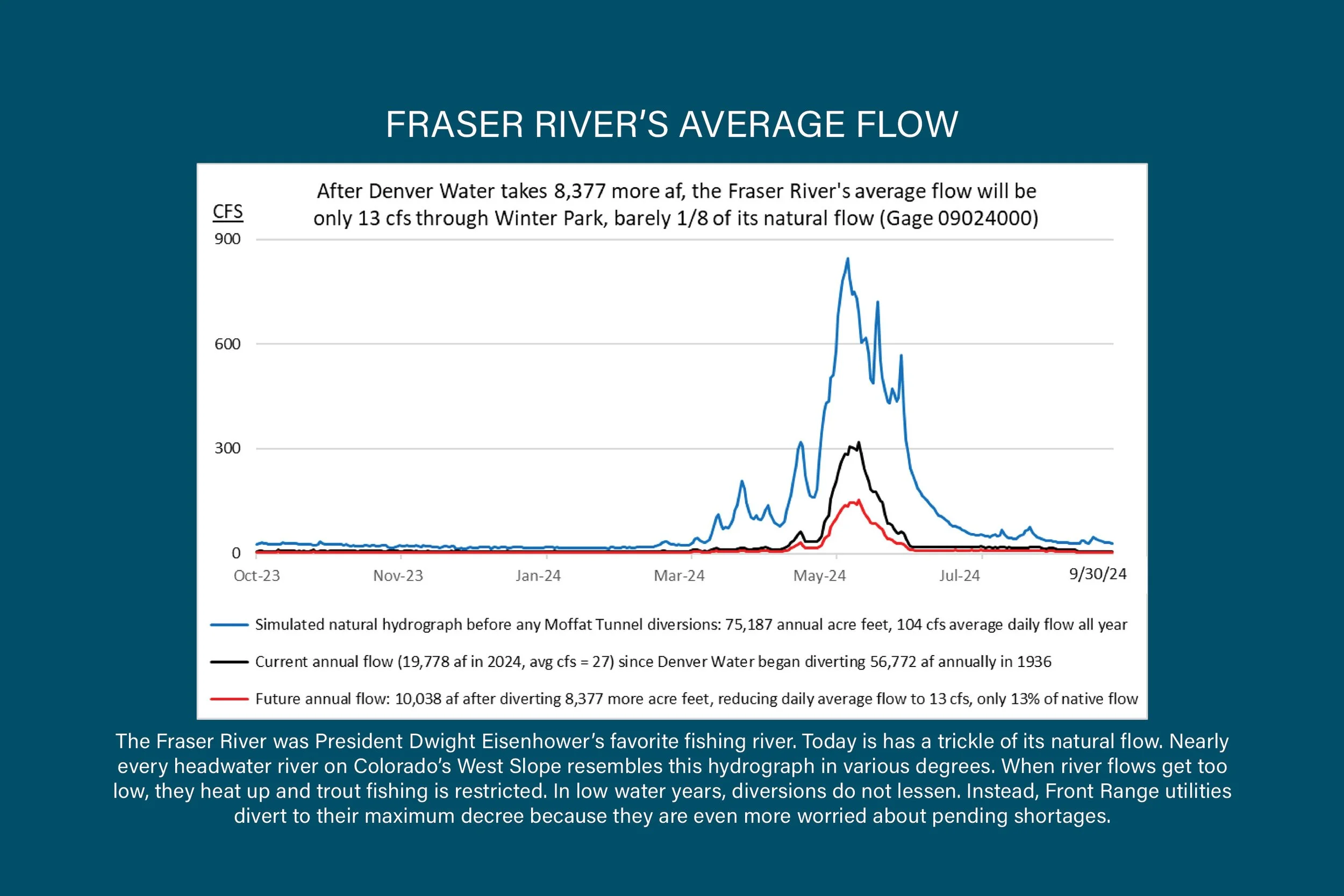
Windy Gap and Moffatt Firming Projects: These projects divert water from the Colorado River’s highest headwaters, the upper Colorado River and Fraser River, reducing their native flow by as much as 90%.
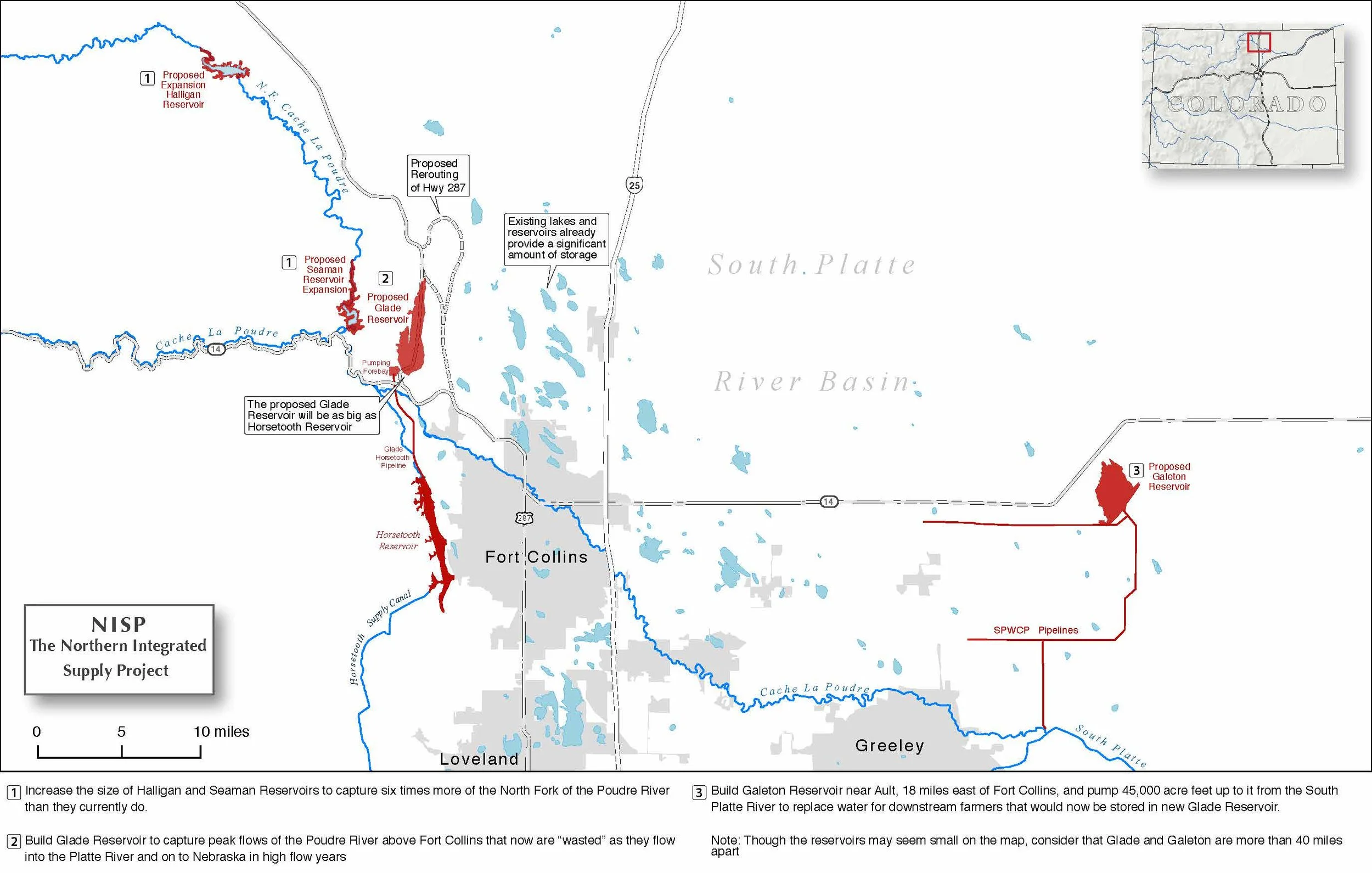
NISP, the Northern Integrated Supply Project: The Northern Colorado Water Conservancy District (“Northern”) has plans to take water from the Poudre River at maximum runoff when the hydrograph peaks.

Colorado Springs, which expects to become Colorado‘s largest city by 2050, Is looking to divert the Eagle River near Vail to Turquoise Reservoir in the Arkansas River Basin, and to add 12’ of concrete to the top of Turquoise and Pueblo Reservoirs to use the extra water diverted from the West Slope.
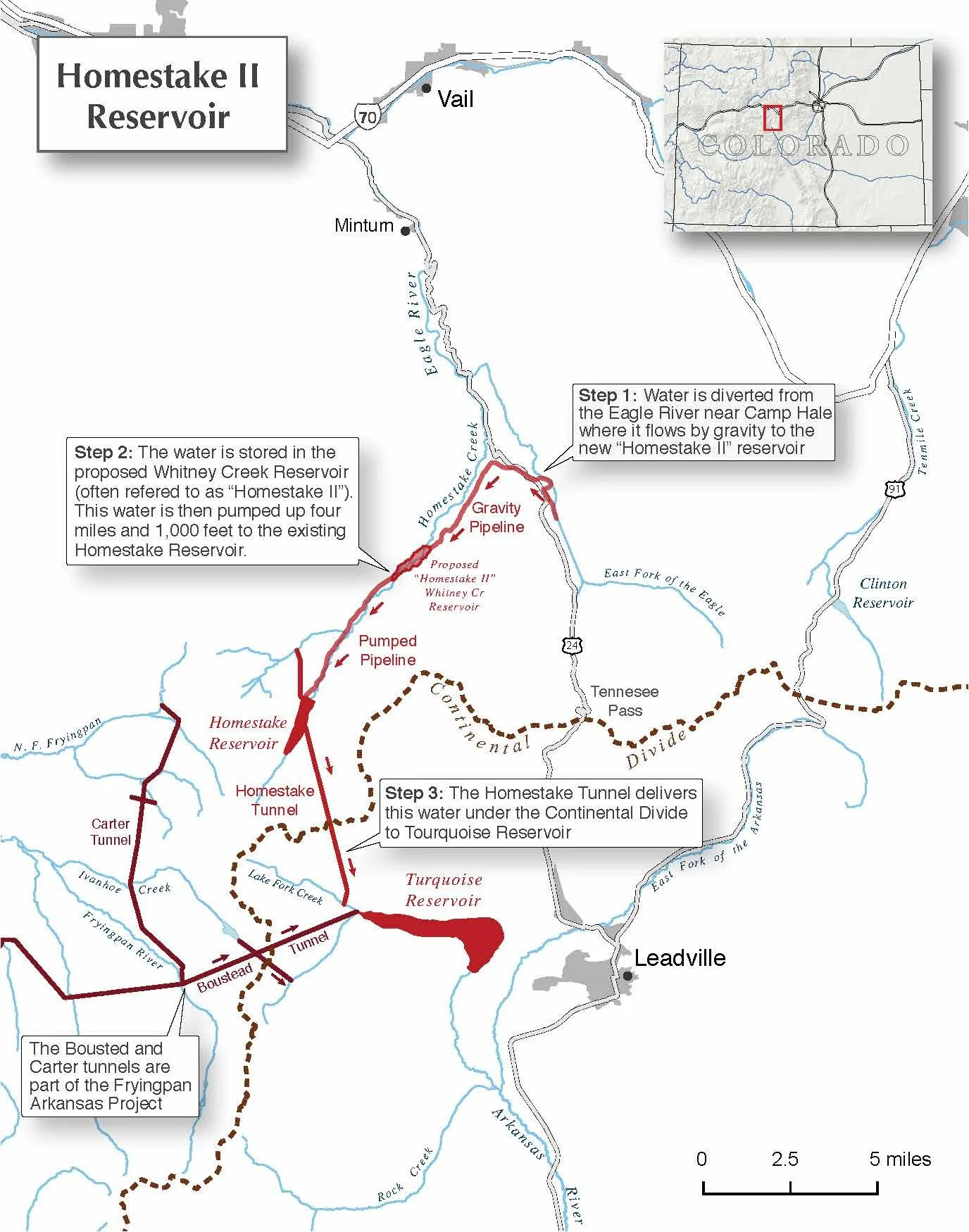
Eagle River MOU (Memorandum of Understanding): Aurora, Colorado Springs, and the Colorado River District based in Glenwood Springs have been quietly advancing this project with little review by the Colorado Basin Roundtable to divert another 10,000 acre-feet to each of Aurora and Colorado Springs.
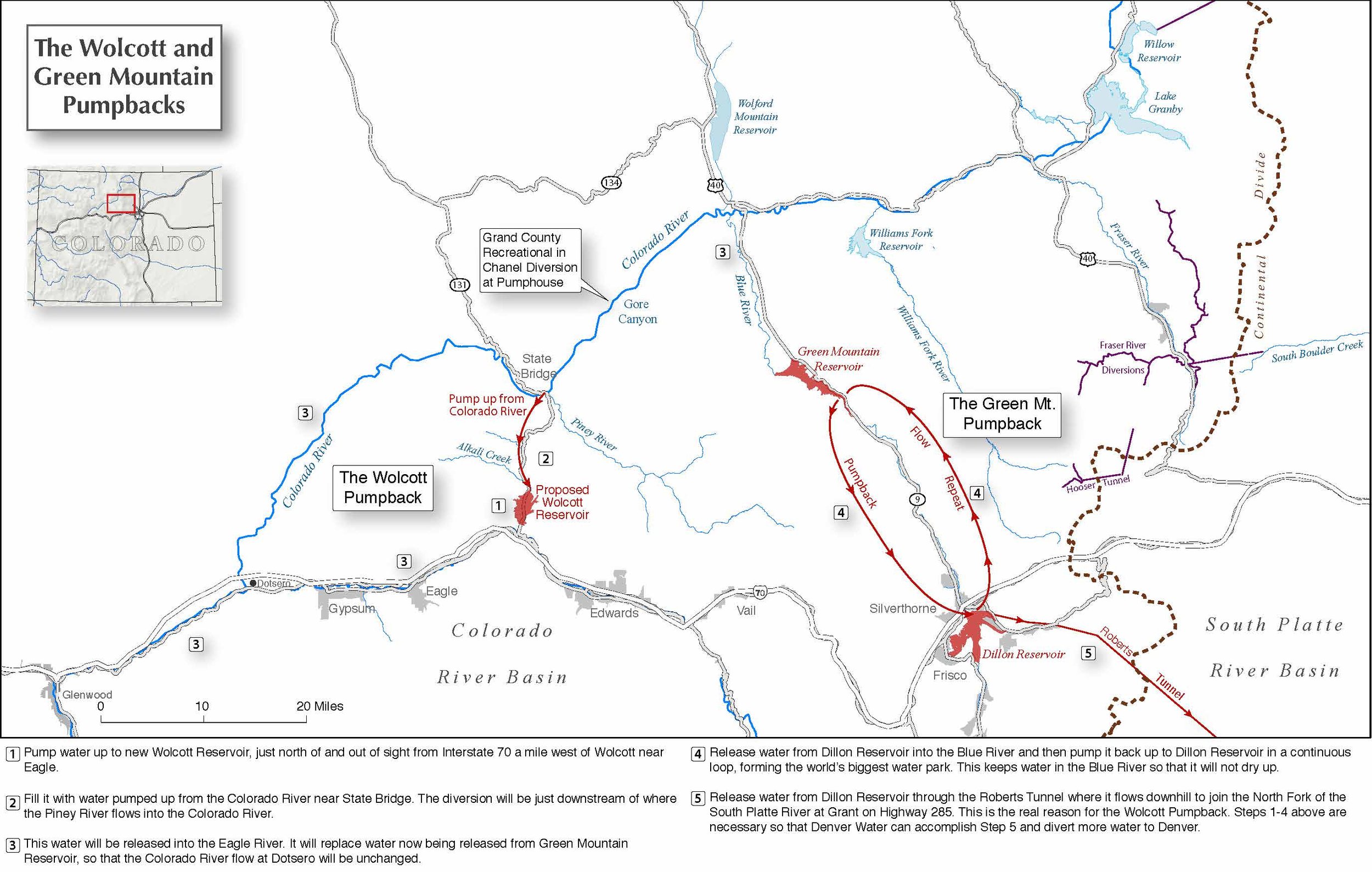
Denver Water plans to fill new Wolcott Reservoir near Eagle with water pumped up from the Colorado River, ultimately so it can send more water from Dillon Reservoir to Denver. It plans to recirculate water between Green Mountain Reservoir and Dillon Reservoir to keep the Blue River from drying up.

The Big Three Pipeline Projects: Three big pipelines are proposed to divert water from the Green River, Yampa River, and Colorado River back to the Front Range. Each is becoming more doubtful as Colorado River flows decrease with hotter temperatures.
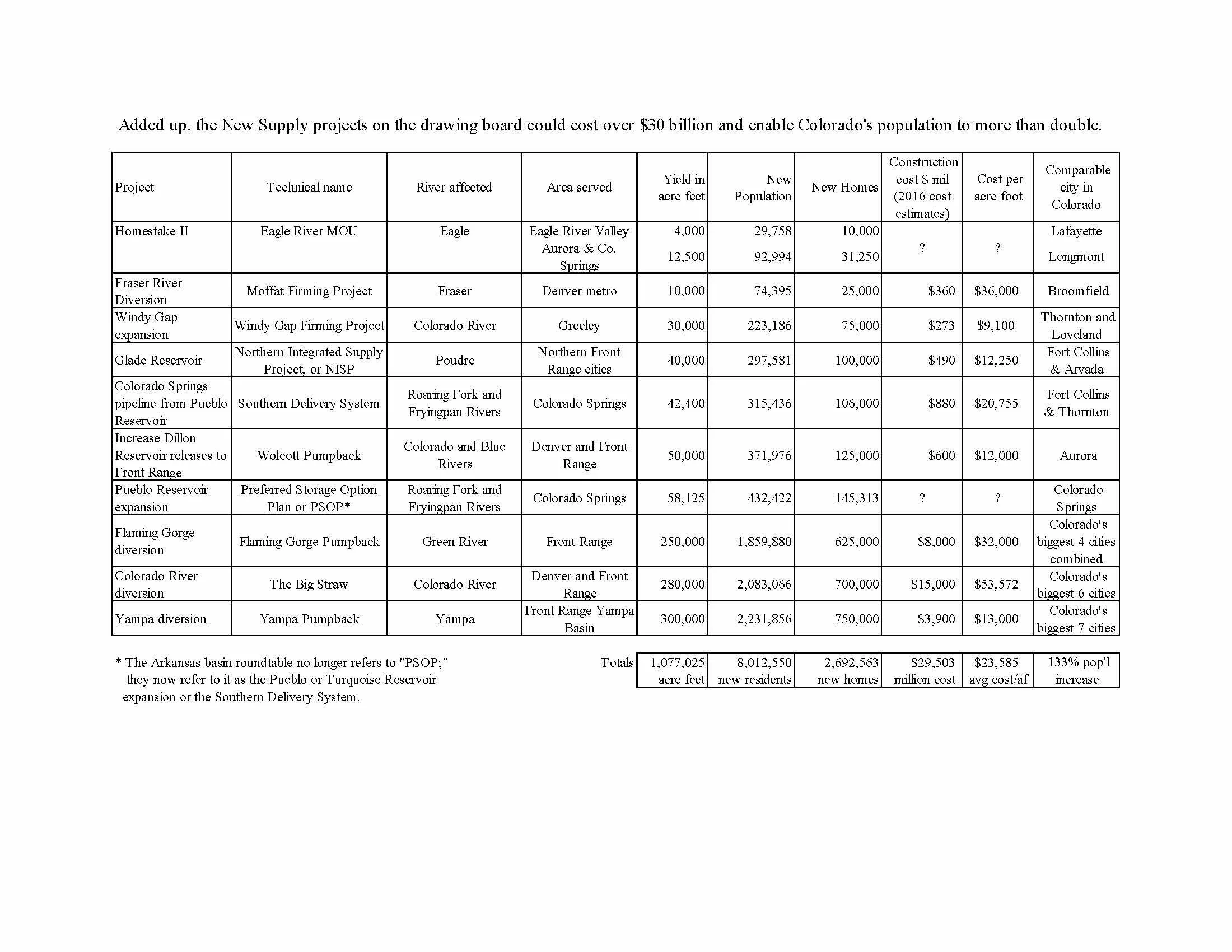
Planned “New Supply” projects from Colorado’s West Slope to the Front Range would more than double the state’s population. Nearly every project would take more water from the Colorado River Basin.
The Water Report Articles by Ken Ransford
Two in-depth articles by Ken Ransford published in The Water Report provide a peek into the topics covered in the book, Whose Law of the River?

Parts 1 and 2: “Colorado River Basin Supply, Demand, and the Law of the River”; and “Colorado River Management, Proposed Alternatives, and What Comes Next”
Ken’s first article, published 7/14/25, lays the foundation for the history and current management structure of the Colorado River, including water rights of Indian Tribes, and detailed data of diminishing water supply levels.
Ken’s second article, published 8/14/25, details current conservation efforts and the Alternatives for post-2026 Colorado River operations that were submitted to Reclamation by various stakeholders. It also provides an overview of Reclamation’s Alternatives Report and a discussion of what we can expect if consensus is not reached.
In the News

“For a long-term solution to the Colorado River crisis, we need to reform century-old laws left over from mining that reward overuse on every field, in every basin, in every state in the West without regard for river health. The Crystal River upstream of Carbondale has all but dried up this year from diversions to grow hay. Instead, we need to provide an incentive for irrigators to conserve water, beyond fallowing for a year, and without the fear that they will lose their water rights.”
Ransford: Legal reform, long-term incentives needed to conserve the Colorado River, by Ken Ransford, published in The Aspen Times on 9/30/26

“When seven states got together in 1922 to effectively divide up Colorado River usage, their resulting compact declared: ‘Nothing in this compact shall be construed as affecting the obligations of the United States of America to Indian tribes.’ So, even more than a century ago, states recognized that Native Americans had rights to Colorado River water and, even earlier in 1908, the U.S. Supreme Court said in Winters v. U.S., that when we dedicated land to reservations it included enough water to make them habitable.”
— Native American Rights to Colorado River Water, by Ken Ransford, article re-published in Daily Kos on 11/13/25 and Native American Netroots

“This process is really a generational opportunity to make better use of the Colorado River, a national treasure and still the lifeblood of civilizations built here millennia before newcomers began allocating resources. It’s also a chance to address a century of brutal procrastination on Indian Water Rights, or we can just revert to the existing policy: Next question, please!”
— Native American Rights to Colorado River Water, by Ken Ransford, published in Santa Monica Daily Press on 8/16/25
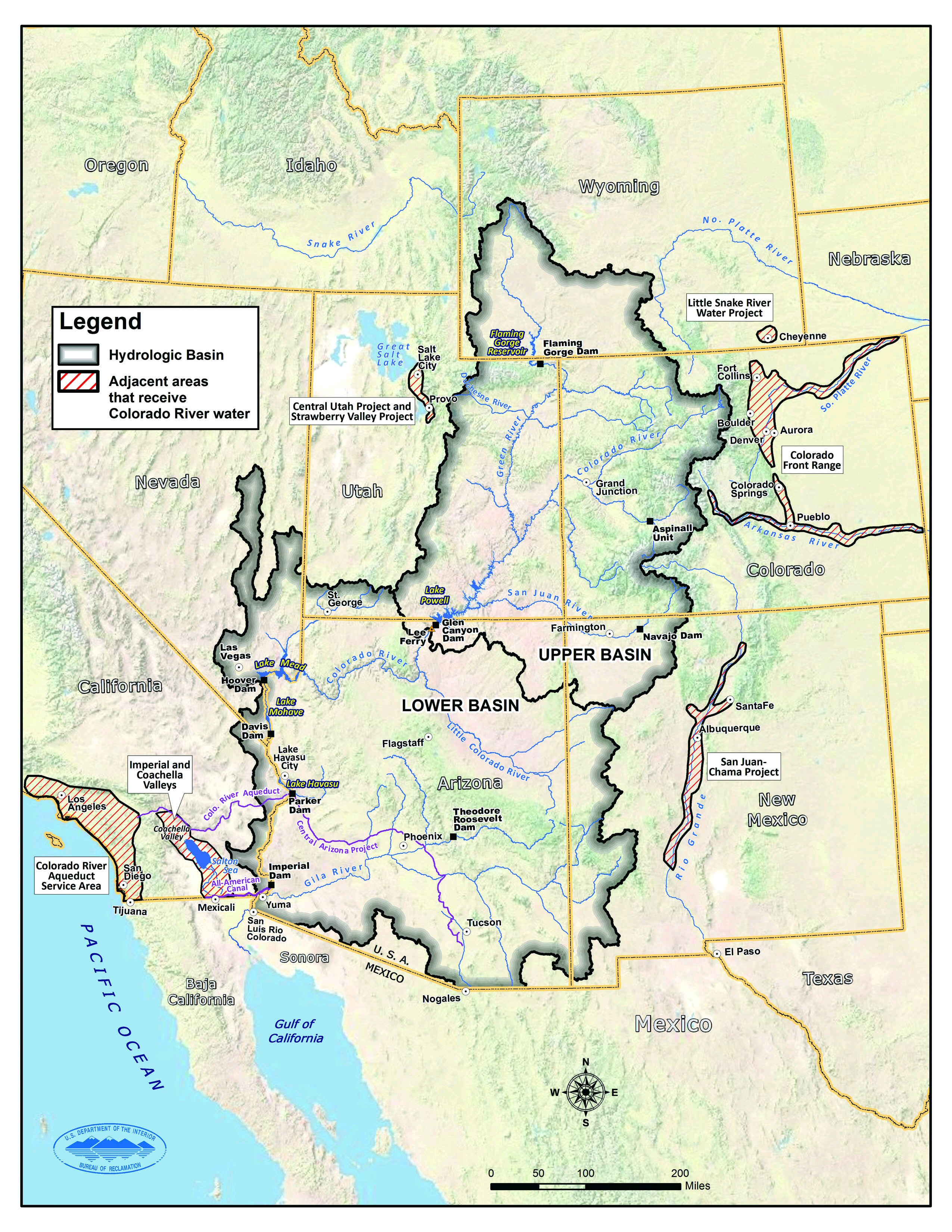
U.S. Bureau of Reclamation map of the Colorado River Basin accessed on October 15, 2024.
More Research & Data
Colorado water law and practice
A deep dive into water law and practice in Colorado, informed by Ken Ransford’s experience as secretary and Recreation Representative to the Colorado Basin Roundtable since inception in 2005. Nine Roundtables were formed by the Colorado legislature in 2005, one for each major river basin in the state, to develop Colorado’s first ever state water plan. Select each chapter to scan the high points, or delve deeper into the text. Extensively footnoted.
-
Topics covered (go right to article):
Instream flows are water rights that preserve minimum river flows, typically with junior priority dates dating from 1973 when the Colorado legislature said that water can be left in the river for the river’s sake. In low-flow periods late in the irrigation season, instream flow rights rarely keep more water in rivers because water rights with earlier priority dates can keep diverting.
Instream flows that have a priority date before 1900 amount to only 0.3 percent of the water used in agriculture. Nearly all were donated to the Colorado Water Conservation Board, or CWCB.
The CWCB, whose mission is to develop Colorado’s water resources, administers instream flows. It has an annual budget of only $1 million to acquire instream flows. Five state agencies must be consulted whenever a new instream flow is proposed. It’s expensive and time consuming to designate instream flows in Colorado.
Colorado’s instream flow statute has been amended 17 times since it was passed in 1972 and has more text than the Colorado River Compact that governs the entire Colorado River.
To appropriate an instream flow, the CWCB must find a natural environment exists that can be improved (i.e., the river does not regularly dry up); water is available for the instream flow; and no other water rights will be injured.
Instream flows can only be designated on rivers that have river gages to monitor instream flows. On January 1, 2025, the US Geological Service USGS monitored only 359 active river gages in Colorado, about six per county.
If an irrigator leaves water in the river by foregoing irrigation or by installing sprinklers, the state engineer cannot protect the water savings as an instream flow, except in special circumstances. Any other irrigator upstream or downstream can divert irrigation efficiency savings left in the river.
Historic irrigation rights can be repurposed as an amenity for private subdivisions, thereby continuing the historic practice of keeping water out of river channels.
Fixing the instream flow law is how we can fix Colorado’s depleted rivers.
-
Topics covered (go right to article):
Colorado has a national reputation for restricting river access.
The case of People v. Emmert took away public access to Colorado rivers in 1979.
Some landowners want to restrict access to rivers to avoid liability, but recreational use statutes protect landowners.
An injured recreator must prove the landowner intentionally injured them in order to recover damages, a case that has never been successfully brought in Colorado.
Some real estate developers have acquired riverfront property in Colorado and then tried to bar the public from floating through despite decades of prior river use.
Landowners claim that floating past their property is a “takings” but they must also prove damages, which likely cannot be proven.
Tourism revenue as a whole grew 3.3 percent per year in Colorado from 2013 to 2023, must faster than the national tourism growth rate of 1.5 percent per year. But fishing tourism revenue has been declining in Colorado compared to other Western states due to the state’s river access rules.
Colorado is one of the leading rafting destinations in the world, with the Arkansas River, the Colorado River from the headwaters to Utah, and Clear Creek west of Denver among the most rafted rivers in the United States.
Other states including Minnesota have much more robust programs to boost river sports.
Cities can claim a water right for recreation flows such as Golden’s water park, but as with instream flows, the recreation water right has a low priority date that it is junior to historic agricultural diversions. Front Range water providers also challenge recreational water right applications.
Dam operators are not required to consider the effect that dam releases have on aquatic life in Colorado.
There are a number of ways to improve river.
-
Topics covered (go right to article):
Unless it’s raining or snow is melting, all water in rivers comes from groundwater.
Rivers follow natural laws that man interferes with at his own peril.
Rivers need to regularly reach bankfull levels to stay healthy. Heavily-diverted Western Slope rivers rarely reach bankfull levels.
We can improve river health by coordinating reservoir releases.
Rivers recover immediately when dams are removed.
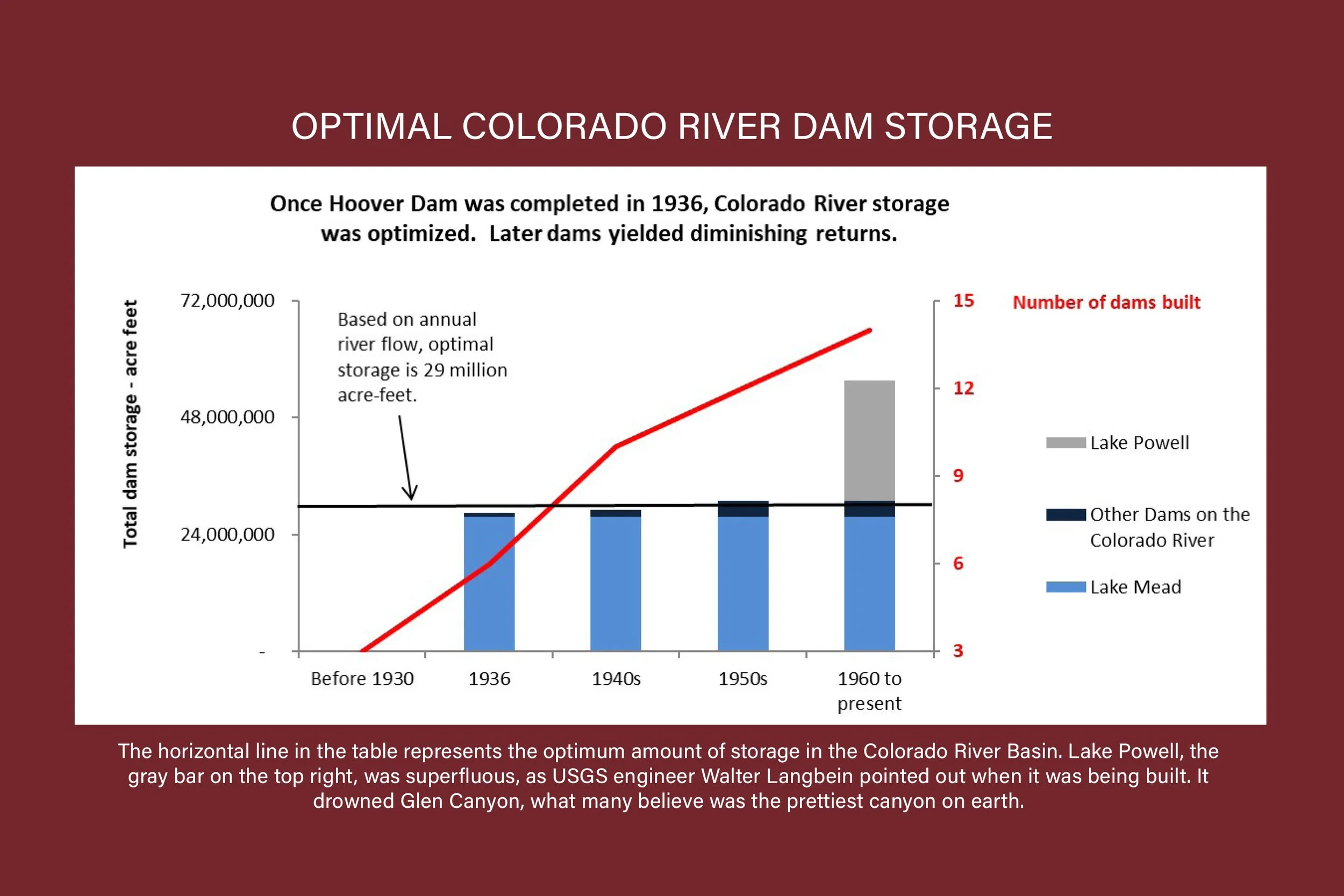
Dams have optimal storage levels, then diminishing returns. Colorado likely reached its optimal storage level many decades ago.
Healthy rivers have a natural hydrograph.
One heart-breaking response to low flows is an engineered solution to narrow channels in rivers that have had their flows reduced by excessive diversions.
River resilience refers to an ecological system’s ability to recover after a shock.
Irrigation diversions impact river health. Colorado law incentivizes irrigators to divert water up to the full amount of the decree without regard to river health.
Stream management plans describe the state of the river and how to improve them. They can take years to develop and irrigators and water managers are often leery of them.
-
Topics Covered (go right to article)…An outline of the array of agencies formed to manage water, their roles, impact and resources. including…
The CWCB was created in 1937, the year modern water development began in Colorado. The CWCB is a state department under the Department of Natural Resources that is charged with protecting and developing Colorado’s water resources.
The Colorado River District was also formed by statute in 1937 to protect west slope irrigators primarily in Grand Junction from diversions through Alva B. Adams Tunnel below Rocky Mt. National Park to the Northern Colorado Water Conservancy District.
The Colorado Water Plan was developed by the CWCB in 2015 and updated in 2023 to estimate water demands from population growth through 2050.
Colorado Water Congress is the most consequential water trade organization in Colorado. It controls the fate of almost all water legislation.
The Roundtables are permanent local bodies created by statute in 2005 to deliberate water matters. Meetings are open to the public.
The CWCB and the Roundtables are independent of each other. A CWCB board member serves as a liaison to each basin roundtable.
The Northern Integrated Supply Project is a plan funded with a $100 million loan from the CWCB to develop Glade Park Reservoir, 170,000 acre feet covering 2.5 square miles, to capture water from the Poudre River where it exits the Rocky Mountains.
Basin Implementation Plans propose $20 billion in new water projects, but plans are spotty in how much detail they provide to describe the projects.
The Interbasin Compact Committee facilitates water transfers between basins. Its Conceptual Framework is the IBCC’s most notable achievement, a 7-point plan to permit more trans-mountain diversions from the west slope to the Front Range.
PSOP, the Preferred Storage Option Plan, is a plan to add 12’ to the height of Turquoise and Pueblo Reservoirs to permit more water to be diverted from the Roaring Fork drainage to the Arkansas Basin.
-
Article covers the following topics (go directly to article):
Four fish that used to be abundant in the Colorado River are classified as endangered species: The razorback sucker, pikeminnow, humpback chub, and bonytail chub, which hasn’t been seen for decades.
Fish ladders are not helping much to facilitate fish passage around the Roller Dam on the Colorado River in De Beque Canyon or Redlands Dam on the Gunnison River.
The US Fish & Wildlife Service drafted the Programmatic Biological Opinion PBO in 1999 to enhance recovery of the endanger species.
Front Range water providers were unwilling to give up the right to buy and dry west slope ranches when the Conceptual Framework was negotiated.
The Colorado pikeminnow has continued to decline since the PBO was written in 1999.
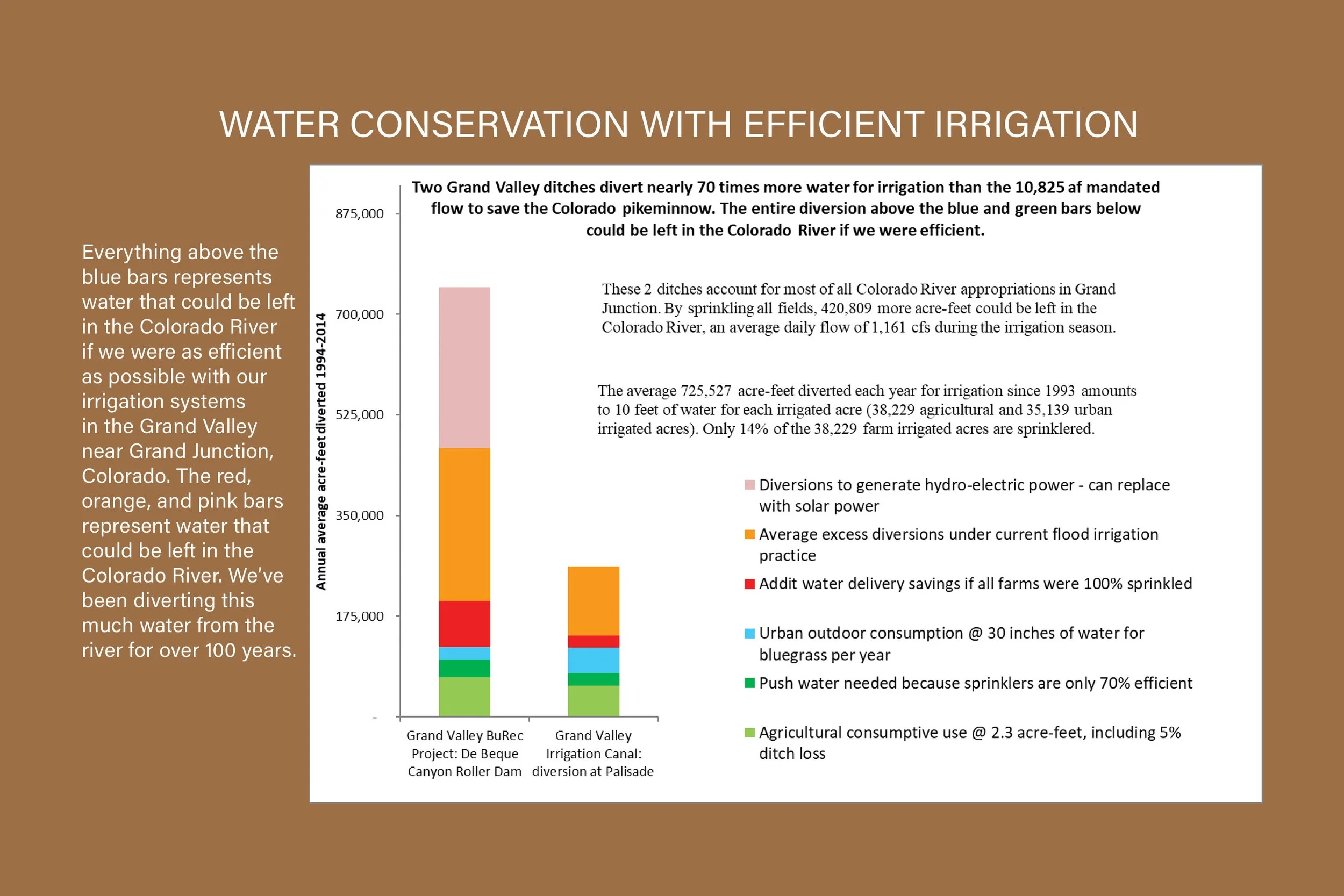
Low flows in the 15-Mile Reach result from diverting over 760,000 acre-feet from the Colorado River to irrigate about 69,000 acres of mostly hay and blue grass.
The National Park Service is paying fishermen to catch and remove brown and rainbow trout from the Colorado River through Grand Canyon, reversing a 145-year practice of stocking the Colorado River with sport fish.
Small mouth bass and walleye pike are starting to invade the Grand Canyon because they have been swept through the outlet tubes as Lake Powell’s elevation has declined.
While the attack on the Endangered Species Act enacted in 1973 has been relentless, it has resulted in several iconic species recovering including the bald eagle.
-
In this article we cover Colorado agriculture, and what that means to the Colorado River (go straight to article). Topics are outlined below:
Cattle dominate Colorado agriculture, consuming 434 gallons of water to produce 1,000 calories of beef.
Hay and corn account for 88% of Colorado’s irrigated agriculture. Corn grown with water pumped from the Ogallala Aquifer is Colorado’s most subsidized crop.
Colorado cow-calf operations are typically small, with 80% of cattle ranches selling fewer than 35 cattle per year.
Meat packing is big business, dominated by the Brazilian company JBS, the largest meat packer in the world whose U.S. headquarters are in Greeley.
14 counties along Colorado’s eastern and northeastern borders collect over 80% of agricultural subsidies in Colorado.
Irrigated land is worth at least three times as much as dry land in Colorado, but less than half what farmland is worth in Iowa east of the 100th Meridian.
Nealy two-thirds of all Colorado farms lose money each year.
Hay is the dominant crop across the entire Colorado River basin from the Rocky Mountains to Baja California, grown on over 3.3 million acres.
Hay reflects policy choices made in the West. Alternative policy choices are examined in a table at the end of the chapter.
-
We explain why we need to reform the river law to support efficient irrigation in order to leave more water in the Colorado. (Go directly to article.)
Colorado law has prohibited water waste since 1876. One statute prohibits waste, but another prohibits it only when a senior water right calls it out. Division engineers rarely call out waste.
Colorado State Engineer Dick Wolfe officially called out wasteful irrigation practices in 2017.
Colorado lacks a public use doctrine unlike nearly every other Western state.
Colorado water court practice is largely limited to determining whether a diversion comports with the prior appropriation doctrine. Water court essentially has no jurisdiction to consider the effect a diversion has on river health.
Reforming Colorado irrigation practices involves enforcing Colorado waste statutes and also modernizing diversions and irrigation delivery systems
The Colorado Basin Roundtable commissioned a survey of ditches in the Eagle County Conservation District in 2016. Despite finding that multiple ditches were in various states of disrepair, the survey was not made public and ditch inefficiencies remain unaddressed.
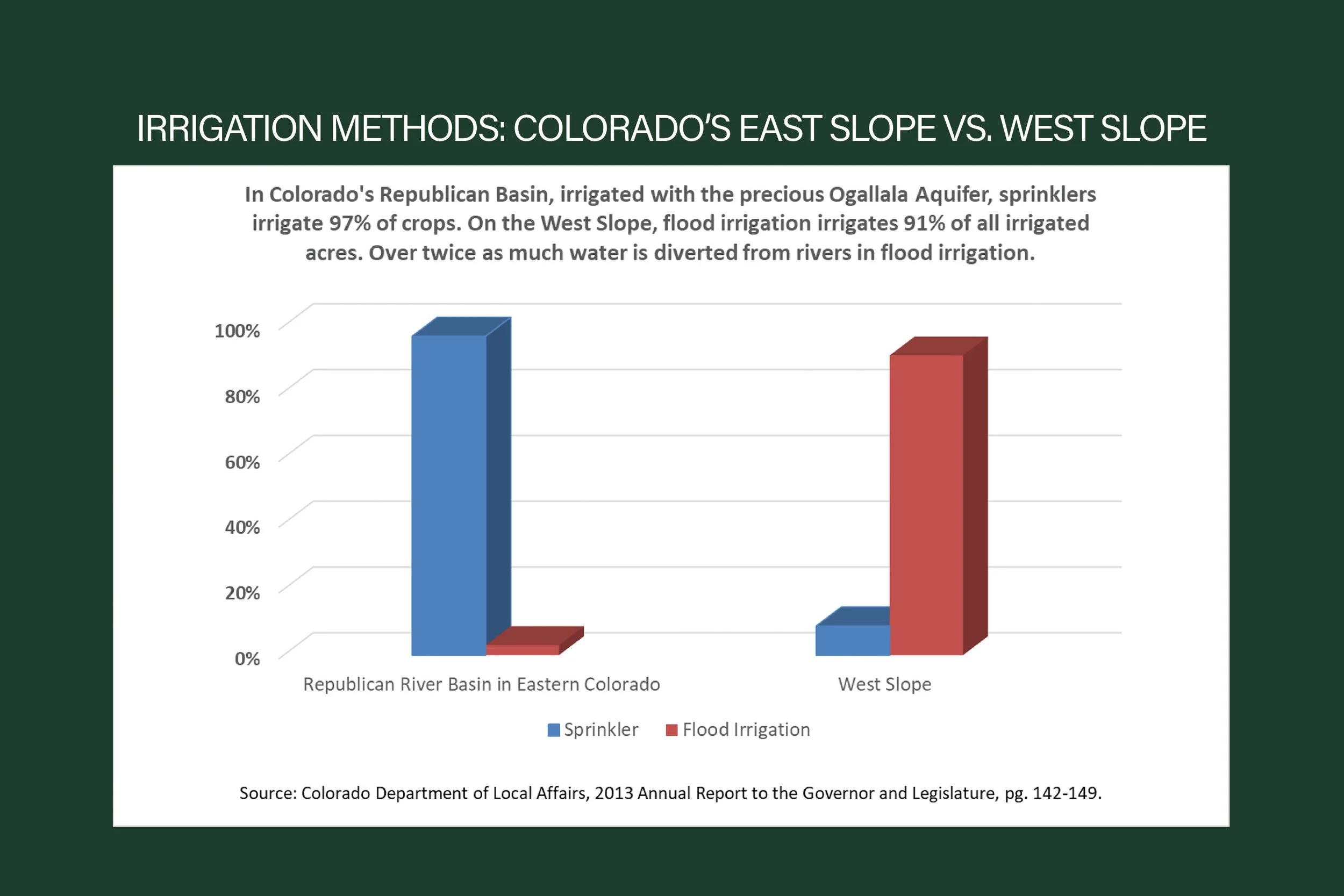
Sprinklers need less than half the water needed in flood irrigation.
It's more expensive to transfer water in Colorado than in any other state. This is another barrier preventing irrigators from investing in modern irrigation systems.
Leaky ditches enlarge decreed water rights because it takes more water to reach the field if the ditch is inefficient.
Efficient irrigation won’t leave more water in the stream under existing law. Prior appropriation permits other irrigators to take additional stream flows that result from efficient irrigation practices. Colorado must address this to improve stream flows.
-
Topics include some of the challenges within the current system and some suggested reforms (go directly to article):
The resume reporting system reports every proposed water transaction in each water division each month.
The Flex Bill would have permitted irrigators to freely transfer water or to preserve it for environmental flows but it failed.
Australia’s Murray-Darling basins, which are dryer than the Colorado River basin, sprinklered nearly every field, eliminated return flows, and now permit water trading.
The Northern Water Conservancy District permits water trading because water rights have been adjudicated and there are no return flow problems since it is transbasin water that can be used to extinction.
Colorado has a tug of war between water court and the state engineer. The state engineer handles water right transfers in every Western state but Colorado, where water court plays the deciding role.
Water rights are subject to change in Colorado if the time, place, or use changes, or if the point of diversion changes. These dissuade water rights holders from ever changing their water use practices because water court change cases are very expensive.
The 2023 Colorado Water Plan ignores irrigation efficiency.
The Pitkin County Healthy Streams Board was asked to provide funding for irrigation ditch efficiency improvements but was unable to leave more water in the Crystal River.
Steps to reform Colorado irrigation water practice are outlined at the end of the chapter.
-
Colorado water law has its origins in mining law when gold was discovered in Central City in 1859, and It has never been amended since it was approved as part of the original state Constitution in 1876. Elwood Mead, the namesake of Lake Mead, recognized Colorado water law shortcomings in 1903. Those shortcomings hold true today, and we walk through how the outdated water law does not address today’s agricultural use and in fact works against leaving water in the river. Topics are outlined below. (Go straight to article.)
Water cases take up an inordinate amount of court time. They amount to less than 1% of the annual court docket in Colorado but take up 16% of court time.
“Thousands of engineering opinions” are potentially available to determine consumptive water use, and all can be disputed according to water court insiders.
High legal costs result from how Colorado administers water law.
Prior appropriation treats the river as free on a first come, first served basis.
The arcane world of water court is so specialized that water lawyers resemble a “tribe.”
The Colorado Constitution makes water law deceptively simple, fitting on one page. It has never been amended since it was approved as part of the original state Constitution in 1876.
Conditional water rights hold your place in line. Known as “paper rights,” they permit water buffaloes to get a prior appropriation date that is superior to later comers.
Abandonment, the “lose it” in “use it or lose it:” Despite rarely being enforced, and not at all on the west slope, abandonment is likely the main driving force in Colorado water use.
Colorado water practice differs from what the law says. In vast swaths of the state, water is used just as it was in the 1880s, and that’s the way irrigators like it.
Wading through a “change case” in water court requires a specialist, and there is no one there to represent the public.
-
This article addresses the affect of population growth on water demand and its affect on the Colorado River. Topics outlined below. (Go right to article.)
Population is growing faster in the West than any other region, with 8 of the 10 fastest growing states between 1950 and 2020.
Cities consume about one-eighth of the water consumed in Colorado.
Existing Colorado residents pay for infrastructure needed for population growth.
Colorado law forbids counties from charging real estate developers for the cost of new schools. Existing residents will pay most of the cost of government buildings, infrastructure, and roads needed for more people.
Of Colorado’s 10 fastest growing counties, nine are on the Front Range. Douglas County has been the fastest growing county since 1980, and Weld County is projected to be the fastest growing county between 2025 and 2050. On the west slope, Eagle County has been growing the fastest since 1980, and Mesa County is projected to grow the fastest over the next 25 years.
Between 2014 and 2024 the median home price grew faster in the West than any other region.
-
We look at perceptions about water in the West and how land planning controls growth, not water availability. We illustrate how water use is highly fragmented among thousands of users and make the argument that water use between urban and agriculture should be balanced. Topics include (go to article):
Proposals to limit municipal water use regularly fail in Colorado.
Citizens should pay more attention to water use decisions, and not leave it up to engineers.
Local control is a catch word for permitting landowners to control water and land use free of governmental oversight.
Landowners can subdivide land into 35-acre parcels by right in Colorado, and drill a well to irrigate up to an acre.
In Colorado, developers are not required to prove a 100- or 300-year water supply is available, they merely need a letter from an engineer or a water provider stating there is adequate water for the proposed development.
Wildland Urban Interface was the fastest-growing land use type in the United States between 1990 and 2010, and 2.6 million more homes were built in the WUI between 2010 and 2020.
The great and growing cities doctrine allows cities to speculate in water by permitting them to acquire water resources that will not be used for decades.
Water planners play an integral role in Colorado growth with minimal public attention.
Conservation easements limit growth. They are voluntary and likely the most effective tool in limiting Colorado sprawl.
Steps that Colorado can take the manage new development are discussed at the end of the article.
-
In this article, we present data showing the unsustainability of tapping into groundwater over the long term. (Go to article.)
Fossil groundwater currently supplies 20% of Colorado’s water consumption.
Half of the South Platte Basin’s water is imported into the basin, either from transmountain diversions, or from fossil groundwater pumping.
The Arapahoe Aquifer is the primary water source for many municipalities between Denver and Colorado Springs and has become unconfined since 2000, evidenced by a drop in water pressure. Production is expected to drop by 85% by 2050.
The Colorado Groundwater Commission regulates 8 groundwater basins in eastern Colorado. It establishes pumping rates that assume a 100-year life for wells.
Groundwater pumping is depleting the Republican River, and Colorado must retire 25,000 irrigated acres by 2030 to comply with a U.S. Supreme Court settlement.
As Colorado keeps drilling new wells in the Denver Basin Aquifer System, the water yielded by each new well keeps dropping.
Colorado refuses to implement USGS recommendations to reduce fossil groundwater mining.
The Ogallala Aquifer is often the first aquifer listed in national and international studies of the world’s fastest declining aquifers.
Official USDA farm policy is to deplete the Ogallala Aquifer.
-
Article outline (go directly to article):
The Colorado Water Plan does not advocate for high municipal conservation, instead opting for low to medium conservation targets.
Passive or active conservation? Passive conservation requires no effort, such as mandating low-flow toilets, but even that has been controversial in Colorado.
Block rates, charging more as water use goes up, helps. Water use in Las Vegas, dropped in half from 1990 to 2013 when rates quadrupled.
Best practices for water conservation can be implemented by utilities to reduce urban consumption. They are optional in Colorado but mandated in California. They are a no-brainer for new construction.
Water budgets can reduce outdoor use by setting targets for residences and reporting how resident’s use compares to the budget or use by others in the neighborhood.
Retrofitting appliances and changing behavior can save 60% of water used indoors. The biggest savings result from changing behavior like flushing toilets less.
Sterling Ranch limits water use to 106 gallons per person per day. This new development of 12,500 homes near Chatfield Reservoir uses 40% less water than the Colorado statewide average use of 172 gallons per person per day.
Paying citizens to replace bluegrass is a slow practice but several cities and organizations promote this. Once bluegrass is replaced, the savings are permanent.
-
Article outline (go directly to article):
Fruita and Mesa County partner to preserve agricultural land. In 1998 they signed an intergovernmental agreement to maintain buffers between growing cities in Grand Junction, and established a Transfer Development Rights program attempting to prevent sprawl and concentrate growth within Fruita town limits.
Most agricultural land is flood-irrigated in Grand Junction, and alfalfa, hay, and corn account for nearly 90% of irrigated agriculture.
The Roller Dam in De Beque Canyon diverts 1,675 cfs from the Colorado River to irrigate 42,000 acres surrounding Grand Junction, nearly half of which has already been urbanized.
The Colorado River could have much more water through Grand Junction if we sprinklered all fields and delivered water through efficient irrigation systems.
A 2008 study by engineers from Cal Poly San Luis Obispo report that Orchard Mesa, which irrigates fields on the south side of the Colorado River, has not been modernized in over 100 years.
In 2017-18, irrigators in the Grand Valley Water User’s Association received payments to cease irrigating, thereby leaving more water in the river to replenish Lake Powell.
The System Conservation Pilot Program paid Grand Junction irrigators with federal funds in 2023-24 to fallow fields, raising concerns of the Colorado River District. Congress declined to fund the program in 2025.
-
Topics in this article include (go straight to the article):
Minute 319 allows Mexico to store water in Lake Mead and when a 2010 earthquake damaged Mexican irrigation structures making them unusable, the U.S. permitted Mexico to store up to 250,000 acre-feet in Lake Mead.
The Salton Trough is continuing to subside as Baja California pulls away from the North American plate.
The Imperial Valley started growing crops when land speculators diverted water from the Colorado River to it in 1905.
As in Colorado, agriculture is the dominant use in the Lower Basin, and hay is the dominant crop. Colorado River water also supports nearly 30 million people in Las Vegas, Phoenix, Tucson, and southern California–cities that are not on any major rivers.
U.S. and Mexico have spent decades grappling with salty deliveries and return flows.
Lower Basin states are reducing water consumption as Lake Mead keeps dropping.
Irrigation efficiency still doesn’t pay for itself. As in Colorado, irrigation efficiency is an afterthought in the lower Colorado River Basin, neither mandated nor practiced in most irrigated fields.
-
This article reviews The Colorado River Compact, which has been in place for over 100 years. (Go directly to article.)
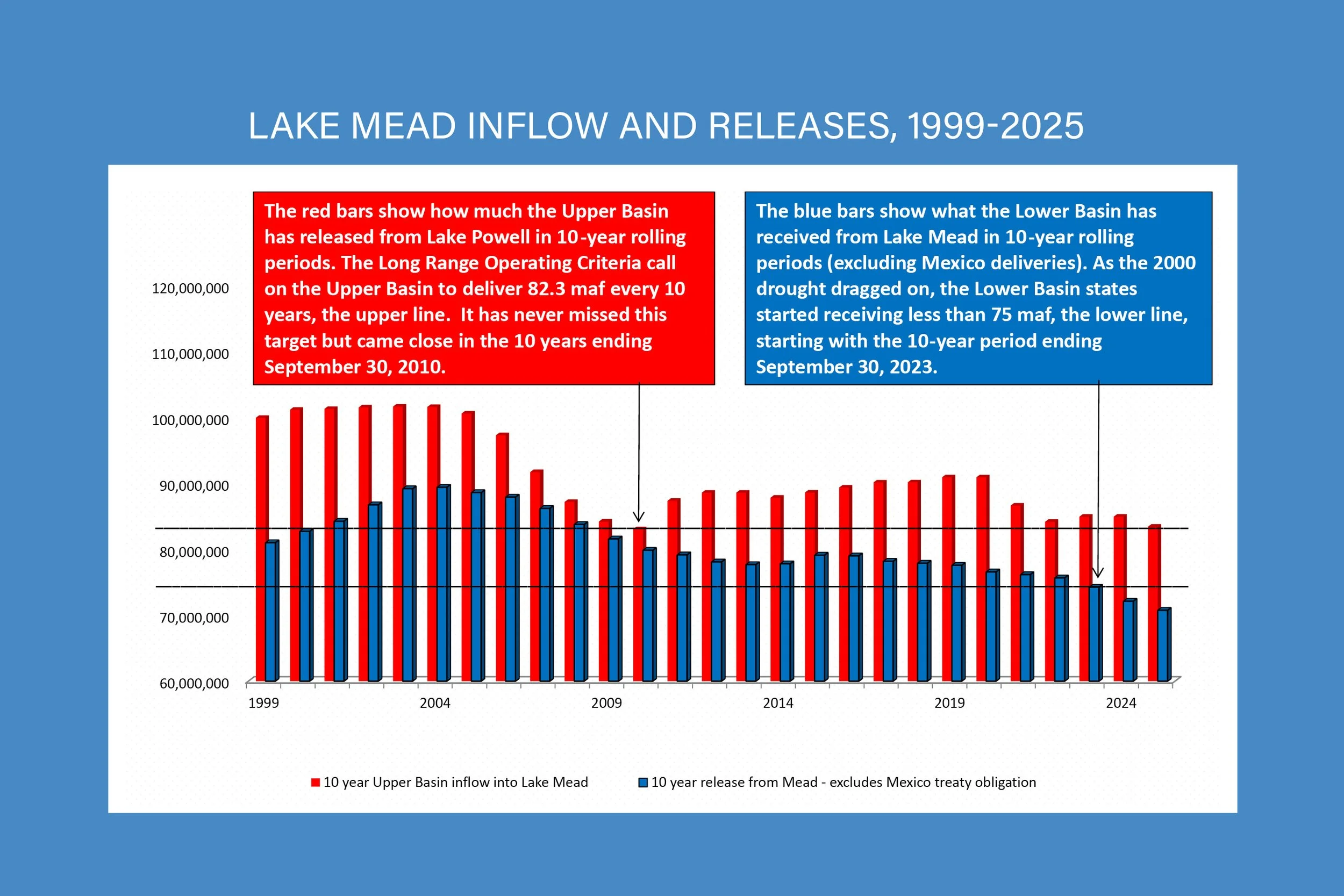
There has never been a Compact Call, but in the past 10 years, deliveries to the Lower Basin states have started decreasing below 7.5 million acre-feet per year.
Delph Carpenter’s simple solution was to allocate 7.5 million acre-feet to each of the Upper and Lower Basins. In a nod to prior appropriation, the Lower Basin’s share was given priority.
Determining whether Colorado has additional water is a guessing game because it is based on the next 10 years’ precipitation, and that cannot be known in advance.
Any new water projects put existing transmountain diversions at risk because nearly all transmountain diversions to the Front Range were developed after the 1922 Colorado River Compact was signed.
Prior appropriation or equitable apportionment is the question. The Colorado River Compact opens, ”The major purposes of this compact are to provide for the equitable division and apportionment of the use of the waters of the Colorado River.” Fear that the U.S. Supreme Court would apportion the Colorado River based on prior appropriation principles motivated Colorado during Compact negotiations.
Colorado claims its obligation is to not deplete the river, a position that suggests other factors such as climate change or transit losses are causing Lake Powell to drop in elevation.
·The Upper Colorado River Basin Compact negotiated in 1948 is based on equitable apportionment—as precipitation changes, the four Upper Basin states of Colorado, Utah, Wyoming, and New Mexico share in the surplus or proportionally reduce their consumption in low water years.
The 10-year penalty box rarely comes up at water meetings but it means Colorado will be the first Upper Basin state to reduce its Colorado River consumption if there is a Compact call.
-
This article shares data about transmountain diversions in Colorado and its role in depleting water from the Colorado River – today it’s about 580,000 acre-feet annually to the Front Range, nearly all from the Colorado River Basin. (Go directly to the article.)
Denver’s water storage has been static for 30 years since building its last major reservoir, Wolford Mountain Reservoir near Kremmling. As new storage projects have tailed off, Denver Water customers have adapted by using less water.
There is not much water left in the Fraser River today since Denver Water diverts 75% of it to the Front Range. It will soon lose nearly 90% of its annual flow after Gross Reservoir above Boulder is expanded.
Dillon Reservoir along I-70 near Silverthorne contributes about 60,000 acre-feet to Denver each year via the Roberts Tunnel into the North Fork of the South Platte River.
Green Mountain Reservoir prevents Denver from diverting still more to the Front Range.
Aurora and Colorado Springs receive water from transmountain diversions on the Blue River, Roaring Fork River, Fryingpan River, and Eagle River.
Draining the Fryingpan and Roaring Fork Rivers has been occurring since the 1930s in order to serve Colorado Springs, Pueblo, and Aurora.
The Colorado Big Thompson Project is the biggest transmountain diversion in Colorado, sending 220,000 acre-feet from Grand Lake to Estes Park each year through the Alva B. Adams Tunnel beneath Rocky Mt. National Park. The annual diversion will increase another 30,000 acre feet once Chimney Hollow Reservoir near Loveland is completed.
-
This article reviews 10 new supply projects in various stages of completion or on the drawing board that promise to transfer more than a million acre-feet annually to the Front Range, enabling the population to more than double. We outline the pros and cons. (Go directly to the article.)
-
This article outlines Ken’s recommendations for several low hanging fruit for Colorado River law reform. (Go straight to article.)
Roundtables aren’t at the table. The Colorado River Cooperative Agreement, Shoshone powerplant flow reduction, Moffat Tunnel and Windy Gap Firming projects, and Eagle River MOU have all been negotiated the past 20 years without any Colorado Basin Roundtable participation.
Leaving more water in the river is not hard to do. Lawyers and water court won’t be helpful, but engineers can assist in modernizing irrigation with sprinklers and efficient ditch devices; amending the instream flow statute can ensure that irrigation efficiency savings stay in the river; eliminating the abandonment rule and expanding the agricultural tax subsidy to an open space subsidy will remove the incentive to dry up rivers; and farm subsidy programs can pay irrigators to leave more water in the river from the Colorado headwaters to the Gulf of California.
The times are changing. While Colorado’s precipitation the past 25 years is in line with hydrology from 1900 to 2000, river flows have declined 15%, likely from aridification.
Make return flows a thing of the past. There’s nothing more damning to Western rivers than our outdated preoccupation with return flows.
Growing hay in the Parker Basin on the California-Arizona border is a folly. Between 1960 and 1980 we more that doubled irrigated acreage in a place that gets barely two inches of rain per year. The main crop has always been hay. The same can be said of the Imperial Valley. Along the Lower Colorado River, less than 25% of water used in irrigation grows crops that people eat. As a result, we’ve dried up the Colorado River Delta, one of the most unique ecosystems on earth.
Colorado needs a grand bargain where the Western slope agrees to meet a Colorado River Compact Call, in return for the Front Range agreeing to cease diverting still more from the west slope.
The risk of a Compact Call is increasing in the face of hotter temperatures, and this is an opportunity to make Colorado water law less rigid and more resilient.
Ken Ransford’s views are his own and do not represent the Colorado Basin Roundtable.