Why we wrote this book and started a nonprofit.
Watch video.
We are happy to send a free copy of “Whose Law of the River?” to our friends in the media.
Please contact us to receive a code to use when ordering a hardcover from our website..
Press
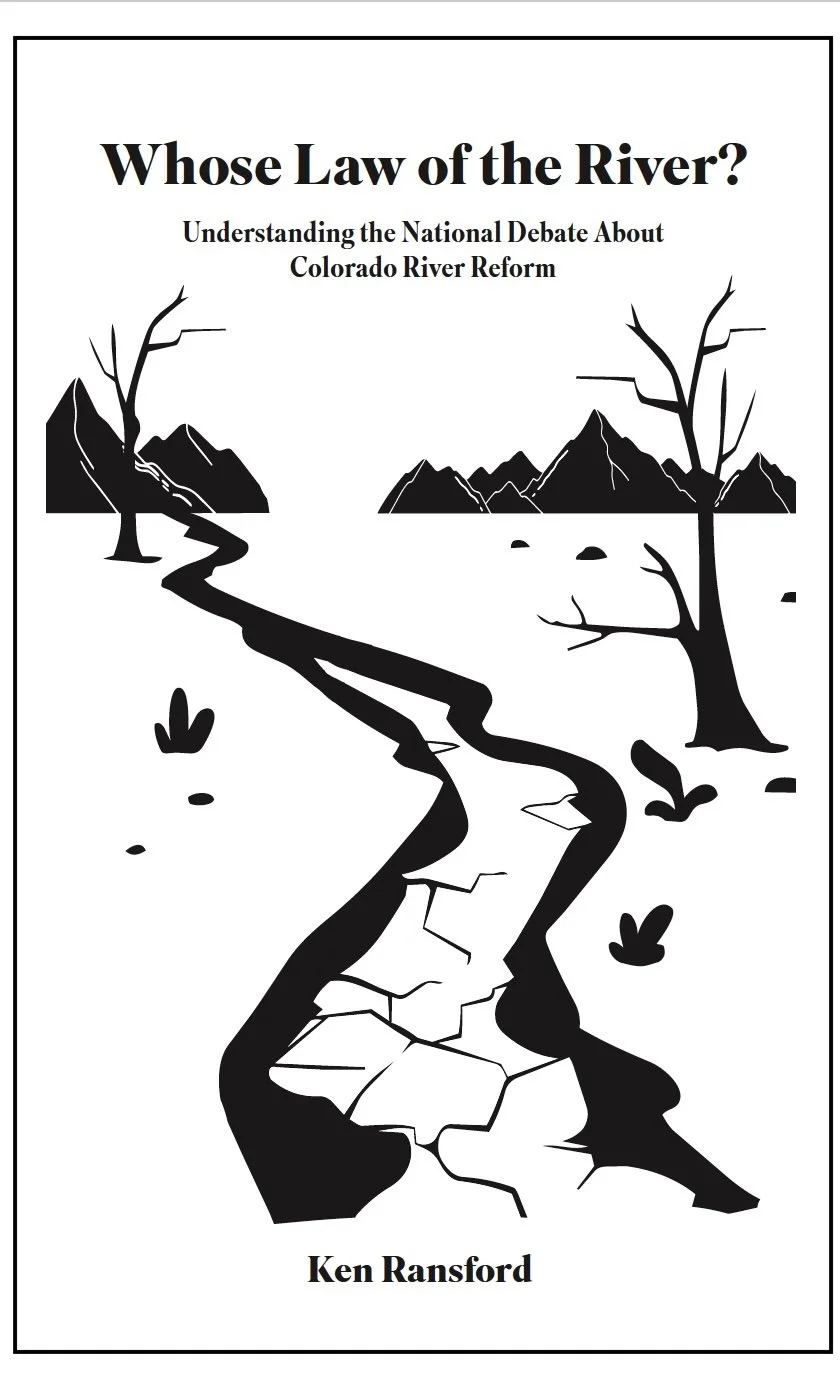
‘Whose Law of the River?’ Provides Context, Solutions for Comprehensive Colorado River Law Reform
Book Release on World Rivers Day Spotlights National Crisis
Basalt, CO (September 24, 2026) – The Bureau of Reclamation, under the Department of the Interior, has declared 2026 as the deadline for the seven affected U.S. states to present alternatives to the antiquated laws governing the Colorado River. However, the states remain at an impasse, and the Trump administration has imposed its own laws on the river. That prompted long-time Colorado River advocate Ken Ransford to write and publish Whose Law of the River?, a book owned by a 501(c)(3) organization with the same name. Ransford connects the dots across states, tribal nations, river personhood, and timelines to explain how we have the best opportunity in over a century to achieve comprehensive Colorado River usage reform. The hard cover will be available for sale on September 27, World Rivers Day, and an e-book was recently released on Kindle.
“Few resources on the planet are as poorly managed as Western water, largely because we deplete almost every river to cultivate hay unless a downstream state has dibs on the water,” says Ransford. “The book explores the historical accidents that have confined us within an inescapable legal framework. Because policy is inextricably bound by these antiquated statutes, we face a systemic barrier to progress unless we abandon century-old laws and come up with common-sense solutions to address the growing water crisis. Climate change is undeniably making things worse and bringing this to a head.”
Ken Ransford’s observations and remarks in Whose Law of the River? are refreshingly candid about why current water laws damage rivers. Leaning on his background as a CPA and lawyer, Ken presents current data to map out short- and long-term solutions to manage the Colorado River so it can once again connect to the Gulf of California and live to serve future generations. His book is informed by his role as secretary and recreation representative to the Colorado Basin Roundtable since 2005, a group formed to draft Colorado’s first state water plan. The Colorado River basin contributes more water to Lake Powell than any other basin, and if there is a ground zero, this is it.
The numbers don’t lie, but the question remains: Whose law of the river will prevail?
About: Whose Law of the River? is a nonprofit project aimed at educating broader audiences about the Colorado River crisis so empowered citizens can fight for the life of the Colorado River. Through easy-to-understand data, Ransford presents common-sense solutions to achieve comprehensive river-usage policy reform. To order the hardcover, go to www.whoselawoftheriver.com. The e-book is available on Kindle at https://bit.ly/45VlUvP.
To schedule an interview with Ken Ransford, please contact Michelle Morel at (207) 329-6767 or michelle@confocalcommunications.com.
Media Contact:
Michelle Morel
Confocal Communications
michelle@confocalcommunications.com
Excerpts
Every user’s incentive is to take water out of rivers. “This story is really pretty simple. Irrigators take as much water out of streams as they legally can, growing hay and other high-water-use crops often shipped overseas to make their water rights look bigger. Cities buy agricultural water rights so they have a future water supply to grow into. They have the same motives as irrigators, to divert as much as possible from the stream so their water rights look bigger. Upper Basin states want to show the highest diversions possible to keep from having to share water with Lower Basin states, so the more water we divert, the better. The system rewards overuse on every field, in every basin, in every state in the West, without regard to river health. And it’s been this way from the 1800s to 2026.”
Native American tribes are short-changed. “The states knew and even acknowledged that Native American Nations had water rights to the Colorado River in 1922, but they did not specify how much the Nations were entitled to. It seems downright progressive, given the times, that Article VII of the 1922 Compact says, ‘Nothing in this compact shall be construed as affecting the obligations of the United States of America to Indian tribes.’... It is no small concession. Today, I estimate that Colorado River tribal Nations are using or being compensated for less than half of the water to which they are entitled. Since tribal rights relate back to when the reservations were created, or earlier, they are likely the oldest water rights to the Colorado River, which means they trump all other water rights. That makes it even more interesting that, back on November 6, just before the seven states were missing their federal deadline and barely six weeks before the 2025 CRWUA conference, the Colorado River Indian Tribes, or CRIT, bestowed ‘personhood’ to the Colorado River. The CRIT proclaimed: ‘The Colorado River has always been and will always be a person under tribal law and will be entitled to the protections under tribal law.’”
The annual Colorado River Water Users Association Conference is a subterfuge. “The CRWUA conference is really a who’s who of water professionals, the lawyers and engineers who earn their living off this regime, and the cities and ranchers who buy and sell and use the water. Colorado was well represented, and I recognized dozens whose careers involve water from around the state. Under current regulation and agreements, Upper Basin states must deliver water to Lake Powell so it can be released to Lake Mead, and it’s the definition of zero-sum—the more the Upper Basin uses, the less the Lower Basin gets. The seven states were supposed to announce the guts of a consensus accord on November 11, 2025, but that deadline came and went with no agreement. The states were hunkered down throughout the conference, and the whole event was a letdown, with participants and speakers doing their best not to say anything of import.”
Colorado’s instream flow law is a subterfuge. “Colorado should stop bragging that it adopted the first instream flow law and instead boast that it has the best instream flow law. Nothing is more out of time than Colorado’s cutesy notion that if someone isn’t using their full allotment of water, anyone else can use it. That might have made sense in Central City in 1859, but the only people I know championing this today are water lawyers trying to zealously protect their clients.”
How to fix the instream flow law. “We need to be able to protect water that is left in the stream by voluntary efforts to make irrigation more efficient, or to irrigate less often or not at all in certain years. And the instream flow statute is the perfect place to add this missing link. It could be the shortest amendment yet to the statute: ‘Water left in the stream from efficient irrigation improvements or from voluntary reduction in consumptive use is a beneficial use and shall be protected from diversion by all junior water right holders.’ Since it is a beneficial use, it eliminates ‘use it or lose it,’ the single biggest impediment to improving stream health.”
Native tribes consider the river to be a person with inalienable rights. ‘Personhood’ acknowledges the Colorado River is a living entity and must be protected under tribal law. The tribal councils, both current and future, must consider the river’s needs in all decision-making processes, and personhood status means the tribe must address damage to the river caused by climate change and overuse.
In March 2024, the Peruvian court in Nauta ruled that the Maranon River (one of the largest headwater tributaries to the Amazon) has intrinsic rights, including the right to flow, to be free from pollution, and to be restored to environmental health. Crucially, the decision recognizes Indigenous communities as the river’s guardians—a role they have always played. There is no law or court decision remotely like this in Colorado that gives the river a voice or any rights.
Colorado River Indian Tribes cannot access their water rights. “CRIT Tribal members also charge that the United States has failed to provide funding for infrastructure so they can fully use their water rights. They recommend a solution to surcharge every acre-foot of Tribal water consumed by non-tribal entities in the Basin and directing those proceeds into a special account to be expended with Tribal support.”
Leave as much as you can vs. take as much as you can. “Right now, water law in Colorado encourages people to take as much water from the river as they can. What if we turned this on its head and instead said, leave as much water in the river as you can? I’m convinced we could leave 30-50% of the water we now divert from most Western Slope rivers without losing a single irrigated acre by simply reforming our law and irrigation practices. Statewide, I estimate we could increase annual river flows by 40% by sprinkling fields rather than flood irrigating them.”
Colorado Water Plan ignores irrigation efficiency and river health. “There wasn’t a single example in the 2023 [Colorado Water] plan that showed how a ranch was improved by irrigation efficiency improvements or sprinklers. Richard McIntyre, an irrigator on the Crystal River, a tributary to the Roaring Fork River, told me his alfalfa yield increased 20% while his water use and labor costs dropped 50% when he switched his field from flood irrigation to sprinklers, whose cost was mostly paid with federal EQIP grants provided by the Natural Resources Conservation Service.”
“I think preserving water in ag is the only way to preserve Colorado ranching, one of the premier lifestyles on earth. But it is marginally profitable, and making irrigation efficient is something all Colorado citizens need to support, not just the ranching community.”